 Solar PV Analysis of Le Lamentin, Martinique
Solar Energy Potential in Le Lamentin, Martinique
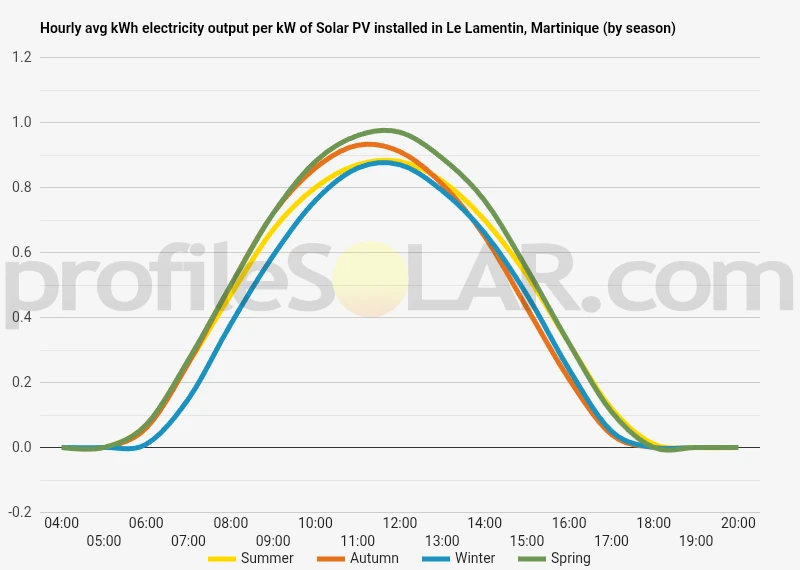
Le Lamentin, Martinique, located at 14.6078° N, 61.0131° W, offers promising conditions for solar PV energy generation throughout the year. This Caribbean location benefits from its tropical positioning, providing relatively consistent solar exposure across all seasons. The seasonal electricity output shows an encouraging pattern with minimal fluctuation: 6.53kWh per day in summer, 6.36kWh in autumn, slightly lower at 5.84kWh in winter, and peaking at 6.99kWh in spring. This represents a difference of only 1.15kWh between the highest and lowest producing seasons, indicating reliable year-round solar generation potential. Spring emerges as the optimal time for solar energy production in Le Lamentin, with winter showing the lowest output. However, even winter production remains substantial compared to many non-tropical locations, demonstrating the advantage of Martinique's geographical position.Optimal Panel Installation
For fixed solar panel installations in Le Lamentin, the ideal tilt angle is 14 degrees facing South. This specific angle has been calculated to maximize year-round energy production based on the location's latitude and solar patterns. Proper panel orientation at this angle can significantly improve overall system efficiency and electricity generation.Environmental Challenges and Mitigation
Several environmental factors in Le Lamentin may affect solar production:- Hurricane exposure: Martinique lies within the Atlantic hurricane belt, with the season typically running from June to November. Strong winds and storms can damage solar installations if not properly secured. Reinforced mounting systems designed to withstand high wind loads are essential.
- Heavy rainfall periods: The wet season brings intense precipitation that can temporarily reduce solar output and potentially cause water damage. Proper waterproofing, drainage systems, and elevated installations can mitigate these concerns.
- Salt corrosion: Proximity to the ocean means salt-laden air can accelerate corrosion of solar equipment. Marine-grade components and regular maintenance can extend system lifespan.
- Tropical humidity: High humidity levels can potentially affect electrical components and connections. Weather-sealed junction boxes and humidity-resistant equipment are recommended.
Note: The Tropics are located between 23.5° North and -23.5° South of the equator.
So far, we have conducted calculations to evaluate the solar photovoltaic (PV) potential in 2 locations across Martinique. This analysis provides insights into each city/location's potential for harnessing solar energy through PV installations.
Link: Solar PV potential in Martinique by location
Solar output per kW of installed solar PV by season in Le Lamentin
Seasonal solar PV output for Latitude: 14.6078, Longitude: -61.0131 (Le Lamentin, Martinique), based on our analysis of 8760 hourly intervals of solar and meteorological data (one whole year) retrieved for that set of coordinates/location from NASA POWER (The Prediction of Worldwide Energy Resources) API:




Ideally tilt fixed solar panels 14° South in Le Lamentin, Martinique
To maximize your solar PV system's energy output in Le Lamentin, Martinique (Lat/Long 14.6078, -61.0131) throughout the year, you should tilt your panels at an angle of 14° South for fixed panel installations.
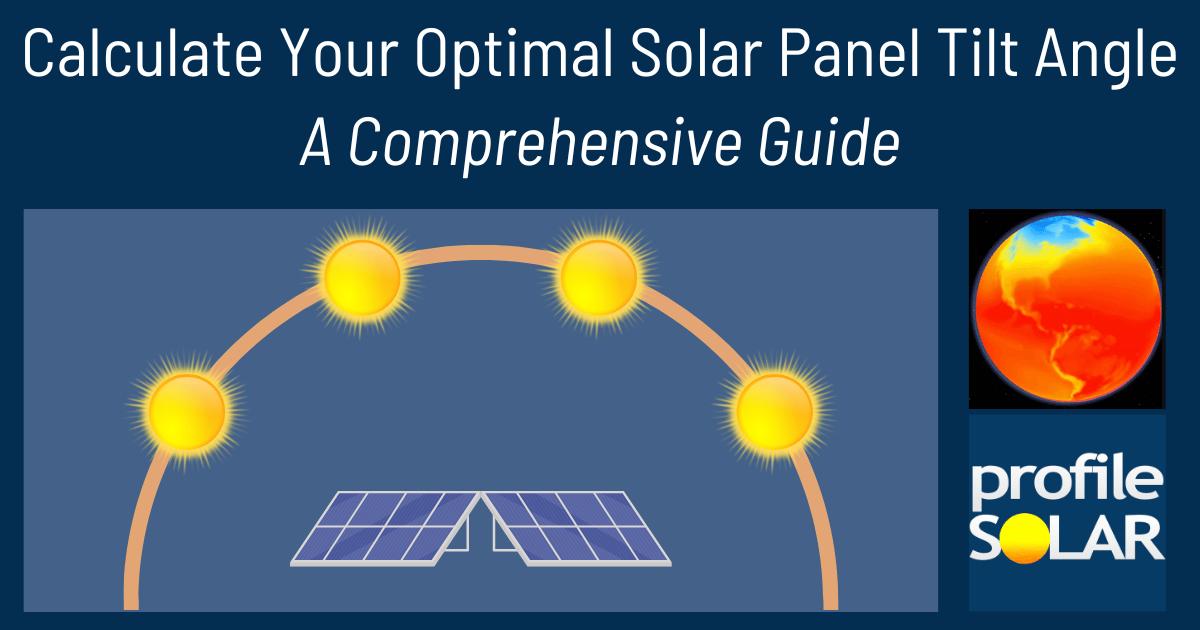
As the Earth revolves around the Sun each year, the maximum angle of elevation of the Sun varies by +/- 23.45 degrees from its equinox elevation angle for a particular latitude. Finding the exact optimal angle to maximise solar PV production throughout the year can be challenging, but with careful consideration of historical solar energy and meteorological data for a certain location, it can be done precisely.
We use our own calculation, which incorporates NASA solar and meteorological data for the exact Lat/Long coordinates, to determine the ideal tilt angle of a solar panel that will yield maximum annual solar output. We calculate the optimal angle for each day of the year, taking into account its contribution to the yearly total PV potential at that specific location.

Seasonally adjusted solar panel tilt angles for Le Lamentin, Martinique
If you can adjust the tilt angle of your solar PV panels, please refer to the seasonal tilt angles below for optimal solar energy production in Le Lamentin, Martinique. As mentioned earlier, for fixed-panel solar PV installations, it is optimal to maintain a 14° South tilt angle throughout the year.
| Overall Best Summer Angle | Overall Best Autumn Angle | Overall Best Winter Angle | Overall Best Spring Angle |
|---|---|---|---|
| 1° North in Summer | 20° South in Autumn | 30° South in Winter | 8° South in Spring |
Our recommendations take into account more than just latitude and Earth's position in its elliptical orbit around the Sun. We also incorporate historical solar and meteorological data from NASA's Prediction of Worldwide Energy Resources (POWER) API to assign a weight to each ideal angle for each day based on its historical contribution to overall solar PV potential during a specific season.
This approach allows us to provide much more accurate recommendations than relying solely on latitude, as it considers unique weather conditions in different locations sharing the same latitude worldwide.
Calculate solar panel row spacing in Le Lamentin, Martinique
We've added a feature to calculate minimum solar panel row spacing by location. Enter your panel size and orientation below to get the minimum spacing in Le Lamentin, Martinique.
Our calculation method
- Solar Position:
We determine the Sun's position on the Winter solstice using the location's latitude and solar declination. - Shadow Projection:
We calculate the shadow length cast by panels using trigonometry, considering panel tilt and the Sun's elevation angle. - Minimum Spacing:
We add the shadow length to the horizontal space occupied by tilted panels.
This approach ensures maximum space efficiency while avoiding shading during critical times, as the Winter solstice represents the worst-case scenario for shadow length.
Topography for solar PV around Le Lamentin, Martinique
Le Lamentin is situated in the central part of Martinique, an island territory in the Lesser Antilles in the eastern Caribbean Sea. The topography around Le Lamentin is characterized by a diverse landscape that transitions from coastal lowlands to rolling hills and eventually to more mountainous terrain as one moves inland. The immediate area around Le Lamentin consists primarily of a broad, flat plain known as the Plaine du Lamentin. This plain represents one of the largest flat areas on the island of Martinique, which is otherwise predominantly mountainous. The flatness of this region is due to its formation from alluvial deposits from the Lézarde River and other smaller waterways that flow through the area. The elevation in this plain is generally low, typically less than 20 meters above sea level.
Coastal Features
To the east of Le Lamentin lies Fort-de-France Bay, a large natural harbor that provides shelter from the open Caribbean Sea. The coastline in this area is characterized by mangrove swamps and mudflats, creating a transitional zone between the terrestrial and marine environments. These coastal wetlands play an important ecological role but present challenges for development due to their sensitive nature and tendency to flood.Surrounding Elevations
As one moves away from the central plain, particularly to the north and northwest, the landscape becomes increasingly hilly. These hills are the foothills of the Pitons du Carbet, a mountain range that dominates the northern part of Martinique. The transition from the flat plain to these hills is relatively gradual, with slopes becoming steeper as one moves further from Le Lamentin. To the south and southwest, the terrain also becomes more elevated, though less dramatically than to the north. This area features a series of rolling hills that eventually lead to the southern peninsula of Martinique.Potential for Solar PV Development
When considering areas near Le Lamentin for large-scale solar photovoltaic (PV) installations, several factors related to topography must be considered: The Plaine du Lamentin itself offers excellent potential for solar PV development. Its flat terrain minimizes construction challenges and costs associated with grading and foundation work. The open nature of the plain also reduces concerns about shading from natural features like mountains or tall vegetation. However, parts of this plain are already developed for agricultural, commercial, and industrial purposes, and some areas may be prone to flooding during heavy rainfall events. The gently rolling hills to the south and southwest of Le Lamentin also present good opportunities for solar PV installations. These areas offer reasonable slopes that can still accommodate large-scale solar arrays without excessive grading requirements. In some cases, south-facing slopes in the northern hemisphere can actually improve solar panel efficiency by optimizing the angle of sunlight reception. The more elevated areas to the north, approaching the Pitons du Carbet, are generally less suitable for large-scale solar developments due to steeper slopes, increased cloud cover at higher elevations, and potential shading issues from the mountains themselves. Areas along the immediate coastline, particularly where mangrove swamps are present, would be poor choices for solar development due to environmental sensitivity, flood risk, and exposure to corrosive salt spray that could damage solar equipment.Other Topographical Considerations
When evaluating specific sites around Le Lamentin for solar PV development, additional topographical factors warrant consideration. Drainage patterns across the landscape affect the risk of flooding and erosion, which could impact solar installation foundations and access roads. The stability of slopes must be assessed, particularly in areas that receive substantial rainfall during the wet season. The volcanic origin of Martinique means that soil composition varies considerably across short distances, potentially affecting construction methods and costs. Some areas may have deeper, more stable soils while others might have shallow soils over volcanic bedrock. In conclusion, the most promising areas for large-scale solar PV development near Le Lamentin would be the flatter portions of the Plaine du Lamentin that are not already developed or environmentally sensitive, followed by the gently rolling hills to the south and southwest that offer good solar exposure without excessive topographical challenges.Citation Guide
Article Details for Citation
Author: Aaron Robinson
Publisher: profileSOLAR.com
First Published: Sunday 15th of June 2025
Last Updated: Monday 8th of September 2025
Tell Us About Your Work
We love seeing how our research helps others! If you've cited this article in your work, we'd be delighted to hear about it. Drop us a line via our Contact Us page or on X, to share where you've used our information - we may feature a link to your work on our site. This helps create a network of valuable resources for others in the solar energy community and helps us understand how our research is contributing to the field. Plus, we occasionally highlight exceptional works that reference our research on our social media channels.
Feeling generous?

Share this with your friends!


Compare this location to others worldwide for solar PV potential
The solar PV analyses available on our website, including this one, are offered as a free service to the global community. Our aim is to provide education and aid informed decision-making regarding solar PV installations.
However, please note that these analyses are general guidance and may not meet specific project requirements. For in-depth, tailored forecasts and analysis crucial for feasibility studies or when pursuing maximum ROI from your solar projects, feel free to contact us; we offer comprehensive consulting services expressly for this purpose.

Helping you assess viability of solar PV for your site
Calculate Your Optimal Solar Panel Tilt Angle: A Comprehensive Guide
Enhance your solar panel's performance with our in-depth guide. Determine the best tilt angle using hard data, debunk common misunderstandings, and gain insight into how your specific location affects solar energy production.