 Solar PV Analysis of Selfoss, Iceland
Solar Energy Potential in Selfoss, South, Iceland
Selfoss, South, Iceland, located at coordinates 63.9313, -20.9925, presents a challenging environment for solar PV energy generation due to its northern latitude, though it still offers viable seasonal production opportunities. The location experiences dramatic seasonal variations in solar energy potential throughout the year, with production heavily concentrated in the warmer months.
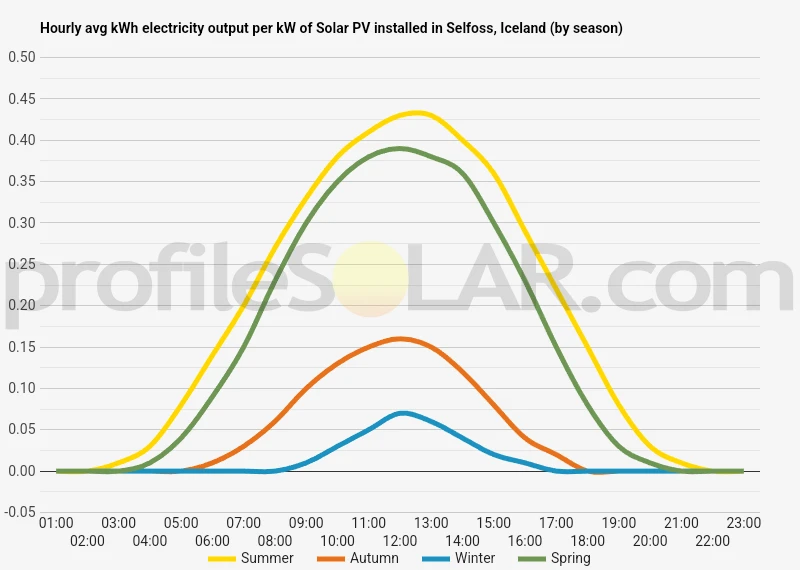
The seasonal solar production data reveals a stark contrast between summer and winter outputs. During summer, panels can generate a respectable 4.29kWh per day for each kilowatt of installed capacity. Spring follows as the second most productive season with 3.48kWh/day. However, production drops significantly during autumn to just 1.05kWh/day, while winter sees minimal generation at only 0.29kWh/day per installed kilowatt.
For maximum year-round energy capture at this Selfoss location, fixed solar panels should be installed at a 53-degree tilt facing south. This specific angle has been calculated to optimize annual production by accounting for the location's northern latitude and seasonal solar patterns.
Seasonal Considerations
The data clearly indicates that solar energy production in Selfoss is highly seasonal. The May-August summer period offers excellent generation potential, making it the prime time for solar energy production. Spring (March-May) also provides good solar yields as daylight hours increase and the sun's angle improves.
The autumn and winter months present significant challenges for solar generation. From September through February, production capabilities drop dramatically, with winter months producing less than 7% of what summer months can generate. This means that solar installations in Selfoss would likely need to be complemented by other energy sources during the darker months.
Environmental Challenges
Several environmental factors can impact solar production at this Icelandic location:
- Snow accumulation during winter months can cover panels, reducing or eliminating production during an already low-yield period
- Volcanic ash from Iceland's active volcanoes can settle on panels, blocking sunlight and reducing efficiency
- Frequent overcast conditions and precipitation can diminish solar irradiance reaching the panels
- Strong winds, particularly in winter storms, may cause physical stress on mounting systems
- Potential salt spray from nearby coastal areas could accelerate corrosion of components
Preventative Measures
To maximize production despite these challenges, several installation strategies can be employed:
- Install panels at steeper angles (the recommended 53 degrees) to promote natural snow shedding
- Use self-cleaning panel technologies or implement regular cleaning schedules to address volcanic ash and other particulates
- Select high-quality, weather-resistant components designed for harsh northern climates
- Implement robust mounting systems rated for high wind conditions
- Consider dual-axis tracking systems to maximize limited winter sunlight, though this must be balanced against increased maintenance in harsh conditions
While Selfoss presents challenges for year-round solar production, thoughtful system design can still make solar PV a valuable component of a diversified energy strategy, particularly during the highly productive summer and spring seasons.
Note: The Northern Temperate Zone extends from 35° latitude North up to 66.5° latitude.
So far, we have conducted calculations to evaluate the solar photovoltaic (PV) potential in 19 locations across Iceland. This analysis provides insights into each city/location's potential for harnessing solar energy through PV installations.
Link: Solar PV potential in Iceland by location
Solar output per kW of installed solar PV by season in Selfoss
Seasonal solar PV output for Latitude: 63.9313, Longitude: -20.9925 (Selfoss, Iceland), based on our analysis of 8760 hourly intervals of solar and meteorological data (one whole year) retrieved for that set of coordinates/location from NASA POWER (The Prediction of Worldwide Energy Resources) API:




Ideally tilt fixed solar panels 53° South in Selfoss, Iceland
To maximize your solar PV system's energy output in Selfoss, Iceland (Lat/Long 63.9313, -20.9925) throughout the year, you should tilt your panels at an angle of 53° South for fixed panel installations.
As the Earth revolves around the Sun each year, the maximum angle of elevation of the Sun varies by +/- 23.45 degrees from its equinox elevation angle for a particular latitude. Finding the exact optimal angle to maximise solar PV production throughout the year can be challenging, but with careful consideration of historical solar energy and meteorological data for a certain location, it can be done precisely.
We use our own calculation, which incorporates NASA solar and meteorological data for the exact Lat/Long coordinates, to determine the ideal tilt angle of a solar panel that will yield maximum annual solar output. We calculate the optimal angle for each day of the year, taking into account its contribution to the yearly total PV potential at that specific location.

Seasonally adjusted solar panel tilt angles for Selfoss, Iceland
If you can adjust the tilt angle of your solar PV panels, please refer to the seasonal tilt angles below for optimal solar energy production in Selfoss, Iceland. As mentioned earlier, for fixed-panel solar PV installations, it is optimal to maintain a 53° South tilt angle throughout the year.
| Overall Best Summer Angle | Overall Best Autumn Angle | Overall Best Winter Angle | Overall Best Spring Angle |
|---|---|---|---|
| 47° South in Summer | 65° South in Autumn | 75° South in Winter | 54° South in Spring |
Our recommendations take into account more than just latitude and Earth's position in its elliptical orbit around the Sun. We also incorporate historical solar and meteorological data from NASA's Prediction of Worldwide Energy Resources (POWER) API to assign a weight to each ideal angle for each day based on its historical contribution to overall solar PV potential during a specific season.
This approach allows us to provide much more accurate recommendations than relying solely on latitude, as it considers unique weather conditions in different locations sharing the same latitude worldwide.
Calculate solar panel row spacing in Selfoss, Iceland
We've added a feature to calculate minimum solar panel row spacing by location. Enter your panel size and orientation below to get the minimum spacing in Selfoss, Iceland.
Our calculation method
- Solar Position:
We determine the Sun's position on the Winter solstice using the location's latitude and solar declination. - Shadow Projection:
We calculate the shadow length cast by panels using trigonometry, considering panel tilt and the Sun's elevation angle. - Minimum Spacing:
We add the shadow length to the horizontal space occupied by tilted panels.
This approach ensures maximum space efficiency while avoiding shading during critical times, as the Winter solstice represents the worst-case scenario for shadow length.
Topography for solar PV around Selfoss, Iceland
The topography around Selfoss, Iceland presents a fascinating blend of geological features shaped by the country's volcanic and glacial history. Selfoss sits in the southern region of Iceland, nestled along the banks of the Ölfusá River, which is Iceland's largest river by volume. The town itself rests on a relatively flat plain, part of the larger South Iceland lowlands that extend from the coastline inland. This southern lowland area where Selfoss is located features predominantly flat to gently rolling terrain, creating a stark contrast to the more mountainous regions found elsewhere in Iceland. The landscape surrounding Selfoss is characterized by fertile agricultural lands, which have been deposited over centuries by glacial activity and river sedimentation. These flat expanses spread outward from the town, particularly to the south and southwest toward the Atlantic coast.
Surrounding Landscape Features
To the north of Selfoss, the terrain gradually rises toward the interior highlands of Iceland. This transition zone features increasing elevation with scattered hills and ridges. Further north, one encounters the edge of Iceland's central highland plateau, a more rugged volcanic landscape with numerous lava fields. The eastern horizon from Selfoss is dominated by the presence of Eyjafjallajökull and Mýrdalsjökull, two prominent ice caps covering active volcanoes. These massive features rise dramatically from the surrounding plains, creating a striking visual backdrop. The 2010 eruption of Eyjafjallajökull famously disrupted air travel across Europe and brought global attention to this region. Westward from Selfoss, the landscape includes the Reykjanes Peninsula, characterized by relatively young volcanic terrain with numerous lava fields, crater rows, and geothermal areas. This peninsula represents the surface expression of the Mid-Atlantic Ridge, where the North American and Eurasian tectonic plates are separating.Potential for Solar PV Development
When considering areas near Selfoss suitable for large-scale solar photovoltaic development, several topographical factors become important. The flat, open plains extending south and southwest of Selfoss offer the most promising terrain for solar installations. These areas provide several advantages: The level terrain minimizes construction challenges and costs associated with ground preparation. These southern lowlands also experience less snow accumulation compared to higher elevation areas, reducing potential seasonal coverage of solar panels. Additionally, the open landscape means fewer natural obstructions that might cast shadows across solar arrays. The coastal plains south of Selfoss toward towns like Eyrarbakki and Stokkseyri represent particularly suitable locations. These areas combine favorable flat topography with proximity to existing electrical infrastructure that connects to Selfoss and the greater Reykjavík area. Areas to the immediate west of Selfoss, following the path of Route 34, also present viable options with similar flat terrain advantages. These locations benefit from proximity to transportation infrastructure, making construction and maintenance more practical. It's worth noting that while Iceland may not immediately come to mind for solar energy production due to its northern latitude, the long summer days provide significant solar potential during part of the year, and modern solar technology continues to improve efficiency even in less optimal conditions. The areas least suited for large-scale solar development would be the northern regions beyond Selfoss, where increasing elevation, more varied terrain, and greater distance from population centers create both practical and economic challenges for solar deployment.Citation Guide
Article Details for Citation
Author: Aaron Robinson
Publisher: profileSOLAR.com
First Published: Tuesday 29th of April 2025
Last Updated: Thursday 18th of September 2025
Tell Us About Your Work
We love seeing how our research helps others! If you've cited this article in your work, we'd be delighted to hear about it. Drop us a line via our Contact Us page or on X, to share where you've used our information - we may feature a link to your work on our site. This helps create a network of valuable resources for others in the solar energy community and helps us understand how our research is contributing to the field. Plus, we occasionally highlight exceptional works that reference our research on our social media channels.
Feeling generous?

Share this with your friends!


Compare this location to others worldwide for solar PV potential
The solar PV analyses available on our website, including this one, are offered as a free service to the global community. Our aim is to provide education and aid informed decision-making regarding solar PV installations.
However, please note that these analyses are general guidance and may not meet specific project requirements. For in-depth, tailored forecasts and analysis crucial for feasibility studies or when pursuing maximum ROI from your solar projects, feel free to contact us; we offer comprehensive consulting services expressly for this purpose.

Helping you assess viability of solar PV for your site
Calculate Your Optimal Solar Panel Tilt Angle: A Comprehensive Guide
Enhance your solar panel's performance with our in-depth guide. Determine the best tilt angle using hard data, debunk common misunderstandings, and gain insight into how your specific location affects solar energy production.