 Solar PV Analysis of Hammerfest, Norway
Solar Energy Potential in Hammerfest, Finnmark, Norway
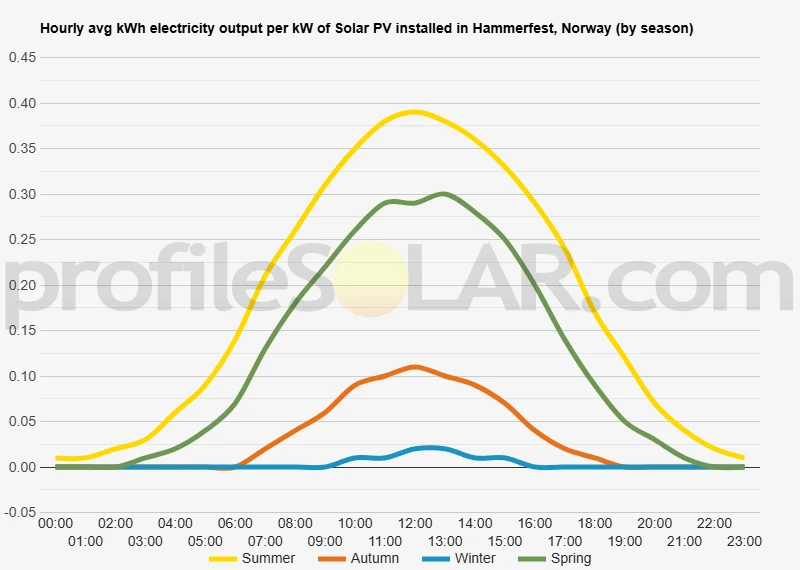
Hammerfest, Finnmark, Norway, located within the Arctic Circle at 70.6611° North, 23.7134° East, presents significant challenges for year-round solar energy production. This northerly location experiences extreme seasonal variations in solar energy potential that make it far from ideal for consistent solar power generation throughout the year. The seasonal solar production at this location shows dramatic fluctuations. During summer, solar panels can generate a respectable 4.31kWh per day for each kilowatt of installed capacity. Spring offers moderate production at 2.88kWh/day per kW installed. However, autumn yields only 0.75kWh/day, and winter production essentially disappears at a mere 0.07kWh/day per kW installed. For anyone considering a fixed solar panel installation in Hammerfest, Finnmark, the ideal tilt angle to maximize year-round energy production is 58 degrees facing South. This angle optimizes the capture of available sunlight across all seasons, though it cannot overcome the fundamental limitations of the Arctic location.Seasonal Considerations
The most productive period for solar energy in Hammerfest is clearly the summer months, when panels can generate over 60% of their rated capacity. Spring represents the second-best season for generation. Together, these two seasons would account for approximately 90% of the annual solar energy production at this location. Autumn and winter are extremely poor for solar generation, with winter being particularly problematic. During winter months, solar panels would essentially produce no meaningful electricity, requiring complete backup from alternative energy sources.Environmental and Weather Challenges
Several significant environmental factors can further impede solar production in Hammerfest:- Snow and ice accumulation on panels during the long winter months can block the already minimal sunlight
- Frequent storms and high winds from the Barents Sea can damage installations
- Salt spray from the nearby ocean can degrade panel efficiency over time
- Low ambient temperatures can affect electrical components and wiring
Note: The Artic Circle includes any location with a latitude North of 66.5°.
So far, we have conducted calculations to evaluate the solar photovoltaic (PV) potential in 114 locations across Norway. This analysis provides insights into each city/location's potential for harnessing solar energy through PV installations.
Link: Solar PV potential in Norway by location
Solar output per kW of installed solar PV by season in Hammerfest
Seasonal solar PV output for Latitude: 70.6611, Longitude: 23.7134 (Hammerfest, Norway), based on our analysis of 8760 hourly intervals of solar and meteorological data (one whole year) retrieved for that set of coordinates/location from NASA POWER (The Prediction of Worldwide Energy Resources) API:




Ideally tilt fixed solar panels 58° South in Hammerfest, Norway
To maximize your solar PV system's energy output in Hammerfest, Norway (Lat/Long 70.6611, 23.7134) throughout the year, you should tilt your panels at an angle of 58° South for fixed panel installations.
As the Earth revolves around the Sun each year, the maximum angle of elevation of the Sun varies by +/- 23.45 degrees from its equinox elevation angle for a particular latitude. Finding the exact optimal angle to maximise solar PV production throughout the year can be challenging, but with careful consideration of historical solar energy and meteorological data for a certain location, it can be done precisely.
We use our own calculation, which incorporates NASA solar and meteorological data for the exact Lat/Long coordinates, to determine the ideal tilt angle of a solar panel that will yield maximum annual solar output. We calculate the optimal angle for each day of the year, taking into account its contribution to the yearly total PV potential at that specific location.

Seasonally adjusted solar panel tilt angles for Hammerfest, Norway
If you can adjust the tilt angle of your solar PV panels, please refer to the seasonal tilt angles below for optimal solar energy production in Hammerfest, Norway. As mentioned earlier, for fixed-panel solar PV installations, it is optimal to maintain a 58° South tilt angle throughout the year.
| Overall Best Summer Angle | Overall Best Autumn Angle | Overall Best Winter Angle | Overall Best Spring Angle |
|---|---|---|---|
| 54° South in Summer | 70° South in Autumn | 79° South in Winter | 61° South in Spring |
Our recommendations take into account more than just latitude and Earth's position in its elliptical orbit around the Sun. We also incorporate historical solar and meteorological data from NASA's Prediction of Worldwide Energy Resources (POWER) API to assign a weight to each ideal angle for each day based on its historical contribution to overall solar PV potential during a specific season.
This approach allows us to provide much more accurate recommendations than relying solely on latitude, as it considers unique weather conditions in different locations sharing the same latitude worldwide.
Calculate solar panel row spacing in Hammerfest, Norway
We've added a feature to calculate minimum solar panel row spacing by location. Enter your panel size and orientation below to get the minimum spacing in Hammerfest, Norway.
Our calculation method
- Solar Position:
We determine the Sun's position on the Winter solstice using the location's latitude and solar declination. - Shadow Projection:
We calculate the shadow length cast by panels using trigonometry, considering panel tilt and the Sun's elevation angle. - Minimum Spacing:
We add the shadow length to the horizontal space occupied by tilted panels.
This approach ensures maximum space efficiency while avoiding shading during critical times, as the Winter solstice represents the worst-case scenario for shadow length.
Topography for solar PV around Hammerfest, Norway
The terrain surrounding Hammerfest in Finnmark, Norway presents a distinctive Arctic coastal landscape. Located on the northwestern coast of the island of Kvaløya, Hammerfest is characterized by a rugged, mountainous topography that reflects its position near the Barents Sea. The landscape features numerous fjords cutting into the coastline, creating a complex shoreline of peninsulas and bays. The area around Hammerfest consists primarily of exposed bedrock formations with relatively sparse vegetation due to the harsh Arctic climate. The mountains are not particularly high by Norwegian standards, typically ranging from 300 to 600 meters above sea level, but they rise steeply from the sea, creating dramatic coastal vistas. These elevated areas are often characterized by rounded summits, evidence of ancient glacial activity that shaped much of northern Norway's landscape during the last ice age.
Coastal Features
The immediate vicinity of Hammerfest includes the sheltered harbor that has made it an important settlement historically. The town itself occupies a relatively flat area along the coast, but is quickly surrounded by rising terrain. The coastal areas feature rocky outcrops and small pebble beaches, with limited flat land available except in small pockets. Nearby islands, including parts of Kvaløya (where Hammerfest is situated), Sørøya to the west, and Seiland to the south, share similar topographical characteristics—mountainous cores with coastal settlements occupying the limited flatter areas near the shoreline.Inland Topography
Moving inland from Hammerfest, the terrain becomes increasingly elevated and rugged. The interior of Kvaløya and the mainland to the south and east feature higher mountains, deeper valleys, and numerous small lakes formed in glacial depressions. These inland areas are marked by exposed rock, alpine tundra vegetation, and in some areas, marshland in the valley bottoms. The region experiences permafrost in some locations, particularly at higher elevations, which influences the stability and composition of the ground. Seasonal frost heaving creates distinctive patterns in the soil and affects vegetation distribution.Potential Areas for Solar PV Development
Despite being located north of the Arctic Circle, certain areas around Hammerfest could be considered for large-scale solar photovoltaic installations, though with important caveats related to the extreme seasonal variations in daylight. The most suitable locations for solar PV development would be: 1. South-facing slopes on the mainland and larger islands that receive maximum exposure to the low-angle Arctic sun. These areas benefit from reflective properties of snow during spring months when sunlight returns but snow cover remains. 2. The relatively flat plateaus found at moderate elevations (200-400m) that provide expansive areas without significant shadowing from adjacent mountains. Several such plateaus exist south of Hammerfest on the mainland. 3. Coastal areas on Sørøya and southern Kvaløya that combine elevation with southern exposure, maximizing potential solar gain during the light season. Areas to avoid would include north-facing slopes, deeply shadowed valleys, and locations with frequent coastal fog or low cloud cover. The steep terrain immediately surrounding Hammerfest town itself presents challenges for large-scale installations, making the somewhat flatter inland plateaus more practical for extensive development. The ideal solar PV locations would balance accessibility (proximity to existing roads and transmission infrastructure) with optimal topographical positioning. Several areas within 20-30 kilometers of Hammerfest, particularly on the southern portions of Kvaløya and on the mainland peninsula, offer this combination of features. It's worth noting that while the extreme seasonal variation in daylight is a significant factor, modern solar PV technology can increasingly handle the low-angle sunlight characteristic of Arctic regions, making thoughtful site selection based on topography especially important.Norway solar PV Stats as a country
Norway ranks 70th in the world for cumulative solar PV capacity, with 225 total MW's of solar PV installed. This means that 0.10% of Norway's total energy as a country comes from solar PV (that's 42nd in the world). Each year Norway is generating 42 Watts from solar PV per capita (Norway ranks 55th in the world for solar PV Watts generated per capita). [source]
Are there incentives for businesses to install solar in Norway?
Yes, there are several incentives for businesses wanting to install solar energy in Norway. The Norwegian government offers a range of financial support and tax breaks for businesses that invest in renewable energy sources such as solar power. This includes grants, loans, and tax deductions. Additionally, the Norwegian Energy Agency provides funding for research and development projects related to renewable energy technologies. Finally, the Norwegian Power Company (Statkraft) offers discounted electricity rates for businesses that use solar power.
Do you have more up to date information than this on incentives towards solar PV projects in Norway? Please reach out to us and help us keep this information current. Thanks!
Citation Guide
Article Details for Citation
Author: Aaron Robinson
Publisher: profileSOLAR.com
First Published: Tuesday 21st of May 2024
Last Updated: Tuesday 22nd of July 2025
Tell Us About Your Work
We love seeing how our research helps others! If you've cited this article in your work, we'd be delighted to hear about it. Drop us a line via our Contact Us page or on X, to share where you've used our information - we may feature a link to your work on our site. This helps create a network of valuable resources for others in the solar energy community and helps us understand how our research is contributing to the field. Plus, we occasionally highlight exceptional works that reference our research on our social media channels.
Feeling generous?

Share this with your friends!


Compare this location to others worldwide for solar PV potential
The solar PV analyses available on our website, including this one, are offered as a free service to the global community. Our aim is to provide education and aid informed decision-making regarding solar PV installations.
However, please note that these analyses are general guidance and may not meet specific project requirements. For in-depth, tailored forecasts and analysis crucial for feasibility studies or when pursuing maximum ROI from your solar projects, feel free to contact us; we offer comprehensive consulting services expressly for this purpose.

Helping you assess viability of solar PV for your site
Calculate Your Optimal Solar Panel Tilt Angle: A Comprehensive Guide
Enhance your solar panel's performance with our in-depth guide. Determine the best tilt angle using hard data, debunk common misunderstandings, and gain insight into how your specific location affects solar energy production.