 Solar PV Analysis of Rykkin, Norway
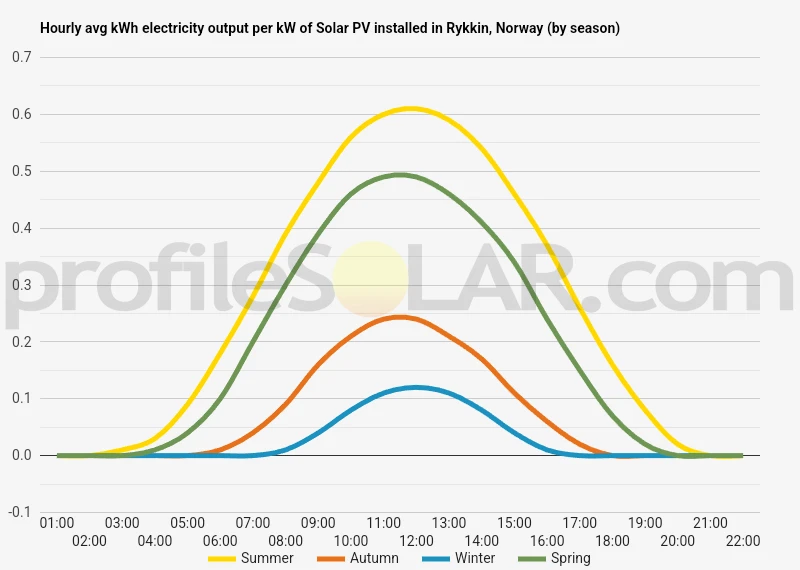
The location at Rykkin, Akershus, Norway, which is in the Northern Temperate Zone, can be used for generating energy through solar photovoltaic (PV) systems. However, it's not ideal throughout the whole year due to varying amounts of sunlight across seasons.
During summer and spring, you can expect a decent amount of electricity generation from solar PV - about 5.72 kilowatt-hours per day for each kilowatt installed in summer and 4.19 kilowatt-hours in spring. These are the best times of the year to generate solar power at this location because there's more daylight time and usually clearer skies.
However during autumn and winter, the output drops significantly to only 1.56 kWh/day per kW installed in autumn and just 0.60 kWh/day per kW installed in winter. This drop is mainly due to shorter daylight hours and less intense sunlight during these seasons.
For a fixed panel installation at this location, tilting panels at an angle of 50 degrees towards South would maximize total yearly production from solar PVs as it helps capture most sunlight over different times of the day throughout all seasons.
As for local factors that might impede solar production here: one key factor could be snowfall during winter months which may cover up your panels making them unable to absorb sunlight effectively until cleared off; another potential issue is low sun angles during wintertime when even clear skies won't provide much useful light for energy generation because sun stays low on horizon all day long.
To counteract these issues:
- You could install automated or manual snow removal systems or regularly clean off your panels manually after snowfalls.
- Using tracking mounts that follow sun’s position across sky instead of fixed mounts could help increase exposure during periods with low sun angles.
- Also consider using higher efficiency panels that perform better under less ideal lighting conditions such as diffuse light on cloudy days or lower intensity light found commonly outside of summer months.
In summary, while Rykkin, Akershus, Norway can be used for solar energy generation, it's most effective in spring and summer months. Some challenges like snowfall and low sun angles in winter could be mitigated with appropriate measures to ensure more consistent energy production year-round.
Note: The Northern Temperate Zone extends from 35° latitude North up to 66.5° latitude.
So far, we have conducted calculations to evaluate the solar photovoltaic (PV) potential in 114 locations across Norway. This analysis provides insights into each city/location's potential for harnessing solar energy through PV installations.
Link: Solar PV potential in Norway by location
Solar output per kW of installed solar PV by season in Rykkin
Seasonal solar PV output for Latitude: 59.9281, Longitude: 10.4965 (Rykkin, Norway), based on our analysis of 8760 hourly intervals of solar and meteorological data (one whole year) retrieved for that set of coordinates/location from NASA POWER (The Prediction of Worldwide Energy Resources) API:




Ideally tilt fixed solar panels 50° South in Rykkin, Norway
To maximize your solar PV system's energy output in Rykkin, Norway (Lat/Long 59.9281, 10.4965) throughout the year, you should tilt your panels at an angle of 50° South for fixed panel installations.
As the Earth revolves around the Sun each year, the maximum angle of elevation of the Sun varies by +/- 23.45 degrees from its equinox elevation angle for a particular latitude. Finding the exact optimal angle to maximise solar PV production throughout the year can be challenging, but with careful consideration of historical solar energy and meteorological data for a certain location, it can be done precisely.
We use our own calculation, which incorporates NASA solar and meteorological data for the exact Lat/Long coordinates, to determine the ideal tilt angle of a solar panel that will yield maximum annual solar output. We calculate the optimal angle for each day of the year, taking into account its contribution to the yearly total PV potential at that specific location.

Seasonally adjusted solar panel tilt angles for Rykkin, Norway
If you can adjust the tilt angle of your solar PV panels, please refer to the seasonal tilt angles below for optimal solar energy production in Rykkin, Norway. As mentioned earlier, for fixed-panel solar PV installations, it is optimal to maintain a 50° South tilt angle throughout the year.
| Overall Best Summer Angle | Overall Best Autumn Angle | Overall Best Winter Angle | Overall Best Spring Angle |
|---|---|---|---|
| 43° South in Summer | 62° South in Autumn | 72° South in Winter | 52° South in Spring |
Our recommendations take into account more than just latitude and Earth's position in its elliptical orbit around the Sun. We also incorporate historical solar and meteorological data from NASA's Prediction of Worldwide Energy Resources (POWER) API to assign a weight to each ideal angle for each day based on its historical contribution to overall solar PV potential during a specific season.
This approach allows us to provide much more accurate recommendations than relying solely on latitude, as it considers unique weather conditions in different locations sharing the same latitude worldwide.
Calculate solar panel row spacing in Rykkin, Norway
We've added a feature to calculate minimum solar panel row spacing by location. Enter your panel size and orientation below to get the minimum spacing in Rykkin, Norway.
Our calculation method
- Solar Position:
We determine the Sun's position on the Winter solstice using the location's latitude and solar declination. - Shadow Projection:
We calculate the shadow length cast by panels using trigonometry, considering panel tilt and the Sun's elevation angle. - Minimum Spacing:
We add the shadow length to the horizontal space occupied by tilted panels.
This approach ensures maximum space efficiency while avoiding shading during critical times, as the Winter solstice represents the worst-case scenario for shadow length.
Topography for solar PV around Rykkin, Norway
Rykkin, Norway is located in a relatively flat region with some small hills and forested areas. The elevation varies from about 100 to 200 meters above sea level. There are residential areas as well as agricultural lands around Rykkin.
The most suitable places for large-scale solar PV installations would be the open, flat areas that receive good sunlight exposure throughout the year. This could include cleared land or agricultural fields that are not currently being used for crops.
However, it's important to note that Norway has a high latitude (around 60 degrees north) which means it has less potential for solar energy compared to countries closer to the equator due to shorter daylight hours especially during winter months.
To maximize efficiency of solar PV in this area, it would be beneficial if panels can be installed on south-facing slopes or rooftops and use tracking systems which follow the sun's path across the sky.
Also, local regulations and environmental considerations such as impact on wildlife or natural scenery should also be taken into account when planning large-scale solar installations.
It's always best practice to conduct a detailed site-specific assessment including sun path analysis before deciding on exact locations for installation of solar panels.
Norway solar PV Stats as a country
Norway ranks 70th in the world for cumulative solar PV capacity, with 225 total MW's of solar PV installed. This means that 0.10% of Norway's total energy as a country comes from solar PV (that's 42nd in the world). Each year Norway is generating 42 Watts from solar PV per capita (Norway ranks 55th in the world for solar PV Watts generated per capita). [source]
Are there incentives for businesses to install solar in Norway?
Yes, there are several incentives for businesses wanting to install solar energy in Norway. The Norwegian government offers a range of financial support and tax breaks for businesses that invest in renewable energy sources such as solar power. This includes grants, loans, and tax deductions. Additionally, the Norwegian Energy Agency provides funding for research and development projects related to renewable energy technologies. Finally, the Norwegian Power Company (Statkraft) offers discounted electricity rates for businesses that use solar power.
Do you have more up to date information than this on incentives towards solar PV projects in Norway? Please reach out to us and help us keep this information current. Thanks!
Citation Guide
Article Details for Citation
Author: Aaron Robinson
Publisher: profileSOLAR.com
First Published: Monday 24th of June 2024
Last Updated: Monday 21st of July 2025
Tell Us About Your Work
We love seeing how our research helps others! If you've cited this article in your work, we'd be delighted to hear about it. Drop us a line via our Contact Us page or on X, to share where you've used our information - we may feature a link to your work on our site. This helps create a network of valuable resources for others in the solar energy community and helps us understand how our research is contributing to the field. Plus, we occasionally highlight exceptional works that reference our research on our social media channels.
Feeling generous?

Share this with your friends!


Compare this location to others worldwide for solar PV potential
The solar PV analyses available on our website, including this one, are offered as a free service to the global community. Our aim is to provide education and aid informed decision-making regarding solar PV installations.
However, please note that these analyses are general guidance and may not meet specific project requirements. For in-depth, tailored forecasts and analysis crucial for feasibility studies or when pursuing maximum ROI from your solar projects, feel free to contact us; we offer comprehensive consulting services expressly for this purpose.

Helping you assess viability of solar PV for your site
Calculate Your Optimal Solar Panel Tilt Angle: A Comprehensive Guide
Enhance your solar panel's performance with our in-depth guide. Determine the best tilt angle using hard data, debunk common misunderstandings, and gain insight into how your specific location affects solar energy production.