Solar PV Analysis of East Islip, United States
East Islip, New York presents a moderately favorable location for solar energy generation, though it experiences significant seasonal variation typical of the Northern Temperate Zone. The area receives its peak solar production during summer months, with output dropping considerably during winter.
Seasonal Solar Performance
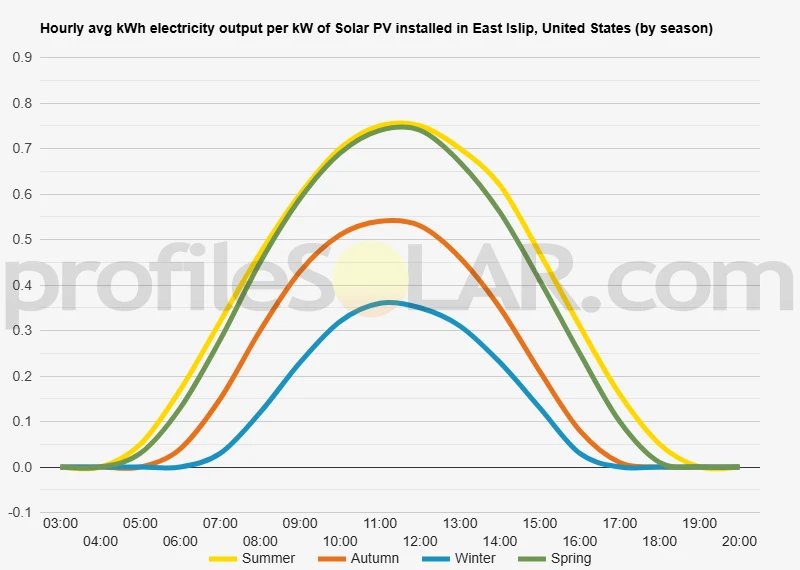
Summer represents the optimal period for solar energy generation at this location, producing 6.14 kWh per day per kW of installed capacity. This high output reflects the combination of longer days and more direct sunlight angles during the warmest months. Spring follows as the second-best season with 5.64 kWh per day per kW, making it nearly as productive as summer. The moderate temperatures and increasing daylight hours create excellent conditions for solar panels. Autumn sees a notable decline to 3.62 kWh per day per kW as the sun angle decreases and daylight hours shorten. Winter presents the most challenging conditions, dropping to just 2.11 kWh per day per kW - representing only about one-third of summer production levels. For maximum year-round energy production, solar panels should be installed at a fixed tilt angle of 35 degrees facing south. This angle optimizes the panels' exposure to sunlight throughout all seasons.Local Factors Affecting Solar Production
Several environmental and weather factors in East Islip can impact solar panel performance:- Snow accumulation during winter months can completely block panels
- Salt air from nearby coastal areas can create corrosive conditions
- Frequent cloud cover and storms, particularly nor'easters
- High humidity levels that can reduce panel efficiency
- Potential for severe weather including hurricanes and strong winds
Preventative Installation Measures
To maximize solar energy production despite these challenges, several installation strategies prove effective: Install panels at the recommended 35-degree tilt angle, which helps snow slide off more easily while optimizing sun exposure. Choose marine-grade mounting hardware and components specifically designed to resist salt corrosion from the coastal environment. Ensure adequate spacing between panels and any nearby trees or structures to minimize shading, particularly important given the lower winter sun angles. Consider installing a monitoring system to quickly identify when panels need cleaning or snow removal. Select high-quality panels with strong wind ratings suitable for coastal storm conditions. Proper grounding and secure mounting become especially critical in areas prone to severe weather events. Regular maintenance scheduling helps address salt buildup and debris accumulation that can reduce efficiency. Professional installation ensures optimal positioning and compliance with local building codes designed for the area's specific weather challenges.Note: The Northern Temperate Zone extends from 35° latitude North up to 66.5° latitude.
So far, we have conducted calculations to evaluate the solar photovoltaic (PV) potential in 4253 locations across the United States. This analysis provides insights into each city/location's potential for harnessing solar energy through PV installations.
Link: Solar PV potential in the United States by location
Solar output per kW of installed solar PV by season in East Islip
Seasonal solar PV output for Latitude: 40.7282, Longitude: -73.1805 (East Islip, United States), based on our analysis of 8760 hourly intervals of solar and meteorological data (one whole year) retrieved for that set of coordinates/location from NASA POWER (The Prediction of Worldwide Energy Resources) API:




Ideally tilt fixed solar panels 35° South in East Islip, United States
To maximize your solar PV system's energy output in East Islip, United States (Lat/Long 40.7282, -73.1805) throughout the year, you should tilt your panels at an angle of 35° South for fixed panel installations.
As the Earth revolves around the Sun each year, the maximum angle of elevation of the Sun varies by +/- 23.45 degrees from its equinox elevation angle for a particular latitude. Finding the exact optimal angle to maximise solar PV production throughout the year can be challenging, but with careful consideration of historical solar energy and meteorological data for a certain location, it can be done precisely.
We use our own calculation, which incorporates NASA solar and meteorological data for the exact Lat/Long coordinates, to determine the ideal tilt angle of a solar panel that will yield maximum annual solar output. We calculate the optimal angle for each day of the year, taking into account its contribution to the yearly total PV potential at that specific location.

Seasonally adjusted solar panel tilt angles for East Islip, United States
If you can adjust the tilt angle of your solar PV panels, please refer to the seasonal tilt angles below for optimal solar energy production in East Islip, United States. As mentioned earlier, for fixed-panel solar PV installations, it is optimal to maintain a 35° South tilt angle throughout the year.
| Overall Best Summer Angle | Overall Best Autumn Angle | Overall Best Winter Angle | Overall Best Spring Angle |
|---|---|---|---|
| 24° South in Summer | 45° South in Autumn | 56° South in Winter | 33° South in Spring |
Our recommendations take into account more than just latitude and Earth's position in its elliptical orbit around the Sun. We also incorporate historical solar and meteorological data from NASA's Prediction of Worldwide Energy Resources (POWER) API to assign a weight to each ideal angle for each day based on its historical contribution to overall solar PV potential during a specific season.
This approach allows us to provide much more accurate recommendations than relying solely on latitude, as it considers unique weather conditions in different locations sharing the same latitude worldwide.
Calculate solar panel row spacing in East Islip, United States
We've added a feature to calculate minimum solar panel row spacing by location. Enter your panel size and orientation below to get the minimum spacing in East Islip, United States.
Our calculation method
- Solar Position:
We determine the Sun's position on the Winter solstice using the location's latitude and solar declination. - Shadow Projection:
We calculate the shadow length cast by panels using trigonometry, considering panel tilt and the Sun's elevation angle. - Minimum Spacing:
We add the shadow length to the horizontal space occupied by tilted panels.
This approach ensures maximum space efficiency while avoiding shading during critical times, as the Winter solstice represents the worst-case scenario for shadow length.
Topography for solar PV around East Islip, United States
Topography of East Islip and Surrounding Areas
East Islip sits on the South Shore of Long Island, New York, characterized by relatively flat coastal plain topography typical of this region. The area features gentle rolling terrain with modest elevation changes, rarely exceeding 100 feet above sea level. The landscape consists primarily of glacial outwash plains formed during the last ice age, creating well-drained sandy soils and subtle undulating hills. The immediate vicinity around East Islip includes a mix of residential neighborhoods, small commercial districts, and patches of preserved woodland. Moving inland from the coast, the terrain gradually rises with gentle slopes, while areas closer to the Great South Bay and Fire Island inlet remain at near sea level. The topography is punctuated by numerous small ponds, wetlands, and creek systems that drain toward the bay.Optimal Areas for Large-Scale Solar Development
The most suitable locations for large-scale solar photovoltaic installations in the East Islip region would be the relatively flat to gently sloping areas found throughout central and eastern Suffolk County. These areas offer the ideal combination of minimal grading requirements, good drainage, and sufficient open space for utility-scale projects. Agricultural areas and former farmland scattered throughout the region present excellent opportunities for solar development. These locations typically feature large, unobstructed parcels with minimal tree cover and existing access roads. The flat to gently rolling topography of these agricultural zones reduces installation costs and maximizes panel efficiency through optimal positioning. Industrial and commercial zones, particularly those with large parking areas or undeveloped lots, also provide suitable terrain for solar installations. Many of these areas have already been cleared and graded, eliminating the need for extensive site preparation. The relatively level ground in these zones allows for efficient panel layout and maintenance access. Former landfills and brownfield sites in the broader Long Island region represent another category of suitable locations. These areas often feature compacted, level surfaces that, while unsuitable for many other development purposes, can be ideal for solar installations with proper engineering considerations. Areas to avoid for large-scale solar development include the numerous wetlands and environmentally sensitive coastal zones that characterize much of the South Shore. Steep slopes, though rare in this region, would also present challenges for installation and maintenance. Heavily forested areas would require significant clearing, making them less economically viable for solar development.United States solar PV Stats as a country
United States ranks 2nd in the world for cumulative solar PV capacity, with 95,209 total MW's of solar PV installed. This means that 3.40% of United States's total energy as a country comes from solar PV (that's 26th in the world). Each year United States is generating 289 Watts from solar PV per capita (United States ranks 15th in the world for solar PV Watts generated per capita). [source]
Are there incentives for businesses to install solar in United States?
Yes, there are several incentives for businesses wanting to install solar energy in the United States. These include federal tax credits, state and local rebates, net metering policies, and renewable energy certificates (RECs). Additionally, many states have enacted legislation that requires utilities to purchase a certain amount of electricity from renewable sources such as solar.
Do you have more up to date information than this on incentives towards solar PV projects in United States? Please reach out to us and help us keep this information current. Thanks!
Citation Guide
Article Details for Citation
Author: Aaron Robinson
Publisher: profileSOLAR.com
First Published: Wednesday 23rd of July 2025
Last Updated: Thursday 7th of August 2025
Tell Us About Your Work
We love seeing how our research helps others! If you've cited this article in your work, we'd be delighted to hear about it. Drop us a line via our Contact Us page or on X, to share where you've used our information - we may feature a link to your work on our site. This helps create a network of valuable resources for others in the solar energy community and helps us understand how our research is contributing to the field. Plus, we occasionally highlight exceptional works that reference our research on our social media channels.
Feeling generous?

Share this with your friends!


Compare this location to others worldwide for solar PV potential
The solar PV analyses available on our website, including this one, are offered as a free service to the global community. Our aim is to provide education and aid informed decision-making regarding solar PV installations.
However, please note that these analyses are general guidance and may not meet specific project requirements. For in-depth, tailored forecasts and analysis crucial for feasibility studies or when pursuing maximum ROI from your solar projects, feel free to contact us; we offer comprehensive consulting services expressly for this purpose.

Helping you assess viability of solar PV for your site
Calculate Your Optimal Solar Panel Tilt Angle: A Comprehensive Guide
Enhance your solar panel's performance with our in-depth guide. Determine the best tilt angle using hard data, debunk common misunderstandings, and gain insight into how your specific location affects solar energy production.