Solar PV Analysis of Greene Village, United States
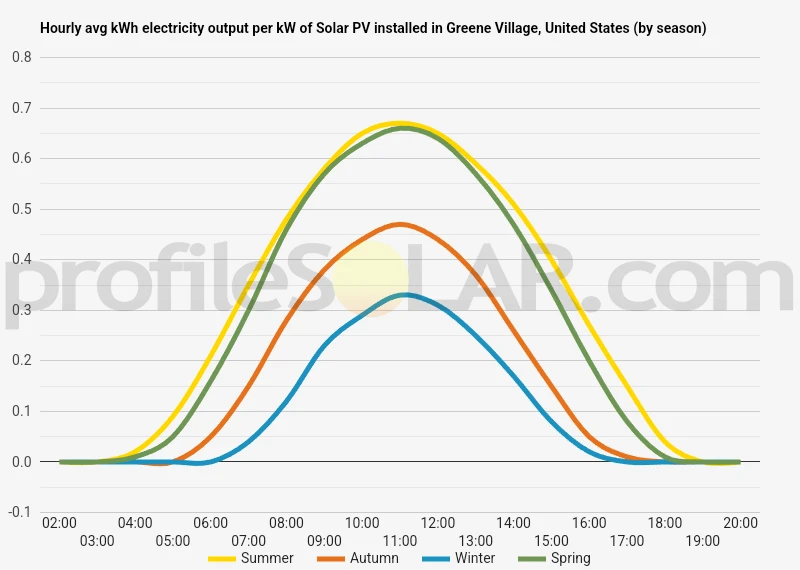
The location at Greene Village, Maine, is decent for generating solar energy throughout the year. However, it's not ideal because the amount of electricity generated varies significantly across seasons.
During summer and spring, you can expect to generate quite a bit of electricity from solar panels installed here. Specifically, in summer you'll get about 5.66 kilowatt-hours (kWh) per day for every kilowatt (kW) of solar panels installed. In spring, this drops slightly to around 5.18 kWh/day per kW.
Autumn sees a further drop in output with only about 3.06 kWh/day produced per kW of installed solar panels - that's less than half what you'd get in summer! Winter is even worse with just 1.84 kWh/day generated per kW.
So while there are times when solar power generation would be quite good in Greene Village – mainly during late spring and throughout summer – during autumn and particularly winter your output will be much lower.
To maximize your total annual production from a fixed panel installation at this location, the best angle to tilt your panels towards is 38 degrees South.
As for potential issues that could impact your ability to generate solar power at this location: weather could certainly play a part given Maine’s climate which includes heavy snowfall during winter months and occasional storms or cloudy days all year round which can block sunlight from reaching the panels effectively reducing their efficiency temporarily until conditions improve again.
To tackle these issues when installing your system:
- Make sure there's easy access so any accumulated snow on the panels can be cleared off quickly.
- Consider using panel coatings or covers designed to help reduce snow accumulation.
- Install systems that monitor weather conditions and adjust accordingly such as tilting or rotating mechanisms if possible.
Remember though that while these measures may help increase efficiency they also add costs so it’s important to weigh up whether they’re worth investing in based on how much extra energy you’d expect to generate as a result.
Note: The Northern Temperate Zone extends from 35° latitude North up to 66.5° latitude.
So far, we have conducted calculations to evaluate the solar photovoltaic (PV) potential in 4253 locations across the United States. This analysis provides insights into each city/location's potential for harnessing solar energy through PV installations.
Link: Solar PV potential in the United States by location
Solar output per kW of installed solar PV by season in Greene Village
Seasonal solar PV output for Latitude: 44.1864, Longitude: -70.1461 (Greene Village, United States), based on our analysis of 8760 hourly intervals of solar and meteorological data (one whole year) retrieved for that set of coordinates/location from NASA POWER (The Prediction of Worldwide Energy Resources) API:




Ideally tilt fixed solar panels 38° South in Greene Village, United States
To maximize your solar PV system's energy output in Greene Village, United States (Lat/Long 44.1864, -70.1461) throughout the year, you should tilt your panels at an angle of 38° South for fixed panel installations.
As the Earth revolves around the Sun each year, the maximum angle of elevation of the Sun varies by +/- 23.45 degrees from its equinox elevation angle for a particular latitude. Finding the exact optimal angle to maximise solar PV production throughout the year can be challenging, but with careful consideration of historical solar energy and meteorological data for a certain location, it can be done precisely.
We use our own calculation, which incorporates NASA solar and meteorological data for the exact Lat/Long coordinates, to determine the ideal tilt angle of a solar panel that will yield maximum annual solar output. We calculate the optimal angle for each day of the year, taking into account its contribution to the yearly total PV potential at that specific location.

Seasonally adjusted solar panel tilt angles for Greene Village, United States
If you can adjust the tilt angle of your solar PV panels, please refer to the seasonal tilt angles below for optimal solar energy production in Greene Village, United States. As mentioned earlier, for fixed-panel solar PV installations, it is optimal to maintain a 38° South tilt angle throughout the year.
| Overall Best Summer Angle | Overall Best Autumn Angle | Overall Best Winter Angle | Overall Best Spring Angle |
|---|---|---|---|
| 28° South in Summer | 48° South in Autumn | 59° South in Winter | 37° South in Spring |
Our recommendations take into account more than just latitude and Earth's position in its elliptical orbit around the Sun. We also incorporate historical solar and meteorological data from NASA's Prediction of Worldwide Energy Resources (POWER) API to assign a weight to each ideal angle for each day based on its historical contribution to overall solar PV potential during a specific season.
This approach allows us to provide much more accurate recommendations than relying solely on latitude, as it considers unique weather conditions in different locations sharing the same latitude worldwide.
Calculate solar panel row spacing in Greene Village, United States
We've added a feature to calculate minimum solar panel row spacing by location. Enter your panel size and orientation below to get the minimum spacing in Greene Village, United States.
Our calculation method
- Solar Position:
We determine the Sun's position on the Winter solstice using the location's latitude and solar declination. - Shadow Projection:
We calculate the shadow length cast by panels using trigonometry, considering panel tilt and the Sun's elevation angle. - Minimum Spacing:
We add the shadow length to the horizontal space occupied by tilted panels.
This approach ensures maximum space efficiency while avoiding shading during critical times, as the Winter solstice represents the worst-case scenario for shadow length.
Topography for solar PV around Greene Village, United States
Greene Village is located in the state of Maine, United States. The topography around Greene Village is characterized by a mix of flat and hilly terrain, with forests, farmland and residential areas interspersed. The region has several rivers and lakes.
When considering large-scale solar PV installations, factors that need to be considered include not just the topography but also the amount of sunlight received throughout the year (solar irradiance), land use regulations, proximity to power grids for transmission etc.
In terms of topography alone, flat lands are generally more suitable for large scale solar PV installations as they require less site preparation work compared to hilly or mountainous terrains. Therefore, open farmlands around Greene Village could potentially be suited for such installations.
However it's important to note that Maine does not receive as much sunlight as other parts of the US like southwest which makes it less ideal from a solar irradiance perspective. Additionally any potential sites would need to meet various regulatory requirements including environmental impact assessments and local zoning laws which may restrict where such facilities can be built.
For a comprehensive assessment on suitability for large scale solar PV installations in this area, a detailed feasibility study taking into account all these factors would need to be undertaken by professionals in this field.
United States solar PV Stats as a country
United States ranks 2nd in the world for cumulative solar PV capacity, with 95,209 total MW's of solar PV installed. This means that 3.40% of United States's total energy as a country comes from solar PV (that's 26th in the world). Each year United States is generating 289 Watts from solar PV per capita (United States ranks 15th in the world for solar PV Watts generated per capita). [source]
Are there incentives for businesses to install solar in United States?
Yes, there are several incentives for businesses wanting to install solar energy in the United States. These include federal tax credits, state and local rebates, net metering policies, and renewable energy certificates (RECs). Additionally, many states have enacted legislation that requires utilities to purchase a certain amount of electricity from renewable sources such as solar.
Do you have more up to date information than this on incentives towards solar PV projects in United States? Please reach out to us and help us keep this information current. Thanks!
Citation Guide
Article Details for Citation
Author: Aaron Robinson
Publisher: profileSOLAR.com
First Published: Sunday 12th of May 2024
Last Updated: Monday 21st of July 2025
Tell Us About Your Work
We love seeing how our research helps others! If you've cited this article in your work, we'd be delighted to hear about it. Drop us a line via our Contact Us page or on X, to share where you've used our information - we may feature a link to your work on our site. This helps create a network of valuable resources for others in the solar energy community and helps us understand how our research is contributing to the field. Plus, we occasionally highlight exceptional works that reference our research on our social media channels.
Feeling generous?

Share this with your friends!


Compare this location to others worldwide for solar PV potential
The solar PV analyses available on our website, including this one, are offered as a free service to the global community. Our aim is to provide education and aid informed decision-making regarding solar PV installations.
However, please note that these analyses are general guidance and may not meet specific project requirements. For in-depth, tailored forecasts and analysis crucial for feasibility studies or when pursuing maximum ROI from your solar projects, feel free to contact us; we offer comprehensive consulting services expressly for this purpose.

Helping you assess viability of solar PV for your site
Calculate Your Optimal Solar Panel Tilt Angle: A Comprehensive Guide
Enhance your solar panel's performance with our in-depth guide. Determine the best tilt angle using hard data, debunk common misunderstandings, and gain insight into how your specific location affects solar energy production.