Solar PV Analysis of San Fernando, United States
San Fernando, California, located in the Northern Sub Tropics at coordinates 34.2876, -118.4329, offers excellent conditions for year-round solar energy generation. The location demonstrates strong solar potential across all seasons, making it a highly suitable area for solar PV installations.
Seasonal Solar Performance
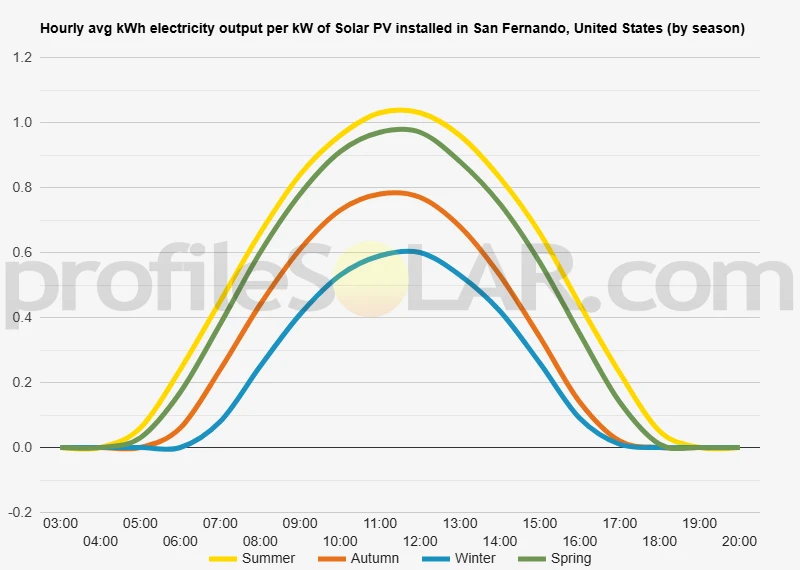
The solar energy output varies significantly throughout the year, with summer providing the highest generation at 8.44 kWh per day per kW of installed capacity. Spring follows as the second-best season with 7.51 kWh per day per kW, while autumn produces 5.35 kWh per day per kW. Winter shows the lowest output at 3.78 kWh per day per kW of installed solar capacity. The ideal times for solar generation at this location are clearly during the warmer months, with summer and spring offering the most productive periods. Even during the less optimal autumn and winter months, the location still maintains reasonable solar output levels that contribute meaningfully to annual energy production.Optimal Panel Configuration
For fixed panel installations at San Fernando, the ideal tilt angle is 30 degrees facing south to maximize total year-round solar production. This angle is calculated by analyzing daily solar elevation angles, determining optimal panel positioning, and weighting these angles using solar irradiance data while accounting for Earth's elliptical orbit.Local Factors Affecting Solar Production
San Fernando faces several environmental challenges that can significantly impact solar energy production:- Air pollution and smog from the greater Los Angeles metropolitan area
- Wildfire smoke during fire season, typically late summer through fall
- Dust accumulation from the semi-arid climate and Santa Ana winds
- Occasional marine layer and coastal fog intrusion
Preventative Measures for Enhanced Performance
Several strategies can help maintain optimal solar production despite these challenges. Regular panel cleaning is essential, with more frequent cleaning recommended during dusty periods and after wildfire events. Installing panels with anti-soiling coatings can reduce dust accumulation and make cleaning more effective. Proper spacing between panel rows ensures adequate airflow for cooling and easier maintenance access. Consider installing monitoring systems that can detect performance drops due to soiling or other issues, allowing for prompt maintenance responses. Choosing high-quality panels with good low-light performance can help maintain output during hazy or smoky conditions. Additionally, ensuring proper electrical connections and using microinverters or power optimizers can minimize the impact when individual panels are affected by shading or soiling. The location's overall solar potential remains very good despite these challenges, and with proper installation and maintenance practices, San Fernando can deliver strong solar energy returns throughout the year.Note: The Northern Sub Tropics extend from 23.5° latitude North up to 35° latitude.
So far, we have conducted calculations to evaluate the solar photovoltaic (PV) potential in 4253 locations across the United States. This analysis provides insights into each city/location's potential for harnessing solar energy through PV installations.
Link: Solar PV potential in the United States by location
Solar output per kW of installed solar PV by season in San Fernando
Seasonal solar PV output for Latitude: 34.2876, Longitude: -118.4329 (San Fernando, United States), based on our analysis of 8760 hourly intervals of solar and meteorological data (one whole year) retrieved for that set of coordinates/location from NASA POWER (The Prediction of Worldwide Energy Resources) API:




Ideally tilt fixed solar panels 30° South in San Fernando, United States
To maximize your solar PV system's energy output in San Fernando, United States (Lat/Long 34.2876, -118.4329) throughout the year, you should tilt your panels at an angle of 30° South for fixed panel installations.
As the Earth revolves around the Sun each year, the maximum angle of elevation of the Sun varies by +/- 23.45 degrees from its equinox elevation angle for a particular latitude. Finding the exact optimal angle to maximise solar PV production throughout the year can be challenging, but with careful consideration of historical solar energy and meteorological data for a certain location, it can be done precisely.
We use our own calculation, which incorporates NASA solar and meteorological data for the exact Lat/Long coordinates, to determine the ideal tilt angle of a solar panel that will yield maximum annual solar output. We calculate the optimal angle for each day of the year, taking into account its contribution to the yearly total PV potential at that specific location.

Seasonally adjusted solar panel tilt angles for San Fernando, United States
If you can adjust the tilt angle of your solar PV panels, please refer to the seasonal tilt angles below for optimal solar energy production in San Fernando, United States. As mentioned earlier, for fixed-panel solar PV installations, it is optimal to maintain a 30° South tilt angle throughout the year.
| Overall Best Summer Angle | Overall Best Autumn Angle | Overall Best Winter Angle | Overall Best Spring Angle |
|---|---|---|---|
| 18° South in Summer | 39° South in Autumn | 49° South in Winter | 27° South in Spring |
Our recommendations take into account more than just latitude and Earth's position in its elliptical orbit around the Sun. We also incorporate historical solar and meteorological data from NASA's Prediction of Worldwide Energy Resources (POWER) API to assign a weight to each ideal angle for each day based on its historical contribution to overall solar PV potential during a specific season.
This approach allows us to provide much more accurate recommendations than relying solely on latitude, as it considers unique weather conditions in different locations sharing the same latitude worldwide.
Calculate solar panel row spacing in San Fernando, United States
We've added a feature to calculate minimum solar panel row spacing by location. Enter your panel size and orientation below to get the minimum spacing in San Fernando, United States.
Our calculation method
- Solar Position:
We determine the Sun's position on the Winter solstice using the location's latitude and solar declination. - Shadow Projection:
We calculate the shadow length cast by panels using trigonometry, considering panel tilt and the Sun's elevation angle. - Minimum Spacing:
We add the shadow length to the horizontal space occupied by tilted panels.
This approach ensures maximum space efficiency while avoiding shading during critical times, as the Winter solstice represents the worst-case scenario for shadow length.
Topography for solar PV around San Fernando, United States
Topography and Terrain of San Fernando
San Fernando sits in the heart of the San Fernando Valley, a broad, relatively flat basin surrounded by mountain ranges in Southern California. The city itself occupies gently rolling terrain at approximately 1,000 feet above sea level, with the land gradually sloping from the surrounding foothills toward the valley floor. The Santa Monica Mountains form the southern boundary of the valley, while the San Gabriel Mountains rise to the northeast and the Santa Susana Mountains create a barrier to the northwest. The immediate area around San Fernando features predominantly flat to gently undulating topography, making it part of one of California's most expansive valley systems. This basin was formed through geological processes over millions of years, creating the relatively level terrain that characterizes much of the San Fernando Valley today. The landscape transitions from urban and suburban development in the valley floor to steeper, more rugged terrain as elevation increases toward the surrounding mountain ranges.Climate and Environmental Conditions
The region experiences a Mediterranean climate with hot, dry summers and mild, relatively wet winters. The valley's position creates a semi-arid environment with low annual precipitation and abundant clear skies throughout much of the year. The surrounding mountains help create a rain shadow effect, contributing to the area's characteristically dry conditions during the warmer months. Temperature variations between day and night can be significant, particularly during winter months, though the overall climate remains favorable for outdoor installations year-round. The area experiences minimal snow or ice, and severe weather events are relatively rare, creating stable environmental conditions for infrastructure development.Optimal Areas for Large-Scale Solar Development
The most suitable locations for large-scale solar photovoltaic installations near San Fernando would be found in the flatter, less developed portions of the San Fernando Valley and the transitional zones leading toward the surrounding mountain foothills. Areas to the north and northwest of San Fernando, including parts of the Santa Clarita Valley, offer extensive flat terrain with minimal topographical obstacles that could interfere with solar panel placement or create shading issues. The Antelope Valley, located further north beyond the San Gabriel Mountains, presents exceptional opportunities for utility-scale solar development. This high desert region features vast expanses of relatively flat, undeveloped land with minimal vegetation and excellent exposure to direct sunlight. The terrain in this area is characterized by gentle slopes and broad, open spaces that can accommodate large solar arrays without significant grading or site preparation challenges. Areas in the western portions of the San Fernando Valley, particularly those with lower population density and less urban development, also provide suitable conditions for solar installations. These locations benefit from the valley's generally flat topography while offering sufficient space for large-scale projects. The relatively stable geological conditions throughout the valley floor make it well-suited for the foundational requirements of solar installations. Desert regions to the northeast, including parts of the Mojave Desert accessible from the San Fernando area, represent some of the most ideal terrain for solar development in Southern California. These areas feature minimal topographical variation, sparse vegetation, and geological stability, along with excellent solar exposure due to their elevation and lack of atmospheric interference from urban pollution or marine layer effects that can affect coastal and valley locations.United States solar PV Stats as a country
United States ranks 2nd in the world for cumulative solar PV capacity, with 95,209 total MW's of solar PV installed. This means that 3.40% of United States's total energy as a country comes from solar PV (that's 26th in the world). Each year United States is generating 289 Watts from solar PV per capita (United States ranks 15th in the world for solar PV Watts generated per capita). [source]
Are there incentives for businesses to install solar in United States?
Yes, there are several incentives for businesses wanting to install solar energy in the United States. These include federal tax credits, state and local rebates, net metering policies, and renewable energy certificates (RECs). Additionally, many states have enacted legislation that requires utilities to purchase a certain amount of electricity from renewable sources such as solar.
Do you have more up to date information than this on incentives towards solar PV projects in United States? Please reach out to us and help us keep this information current. Thanks!
Citation Guide
Article Details for Citation
Author: Aaron Robinson
Publisher: profileSOLAR.com
First Published: Wednesday 23rd of July 2025
Last Updated: Thursday 7th of August 2025
Tell Us About Your Work
We love seeing how our research helps others! If you've cited this article in your work, we'd be delighted to hear about it. Drop us a line via our Contact Us page or on X, to share where you've used our information - we may feature a link to your work on our site. This helps create a network of valuable resources for others in the solar energy community and helps us understand how our research is contributing to the field. Plus, we occasionally highlight exceptional works that reference our research on our social media channels.
Feeling generous?

Share this with your friends!


Compare this location to others worldwide for solar PV potential
The solar PV analyses available on our website, including this one, are offered as a free service to the global community. Our aim is to provide education and aid informed decision-making regarding solar PV installations.
However, please note that these analyses are general guidance and may not meet specific project requirements. For in-depth, tailored forecasts and analysis crucial for feasibility studies or when pursuing maximum ROI from your solar projects, feel free to contact us; we offer comprehensive consulting services expressly for this purpose.

Helping you assess viability of solar PV for your site
Calculate Your Optimal Solar Panel Tilt Angle: A Comprehensive Guide
Enhance your solar panel's performance with our in-depth guide. Determine the best tilt angle using hard data, debunk common misunderstandings, and gain insight into how your specific location affects solar energy production.