 Solar PV Analysis of Arame, Brazil
Arame, Maranhão, Brazil represents an excellent location for year-round solar energy generation. Located in the tropical region at coordinates -5.0316, -45.8632, this area benefits from consistent sunlight throughout most of the year, with seasonal variations typically defined by wet and dry periods rather than the temperature-based seasons found in temperate climates.
Solar Energy Production Potential
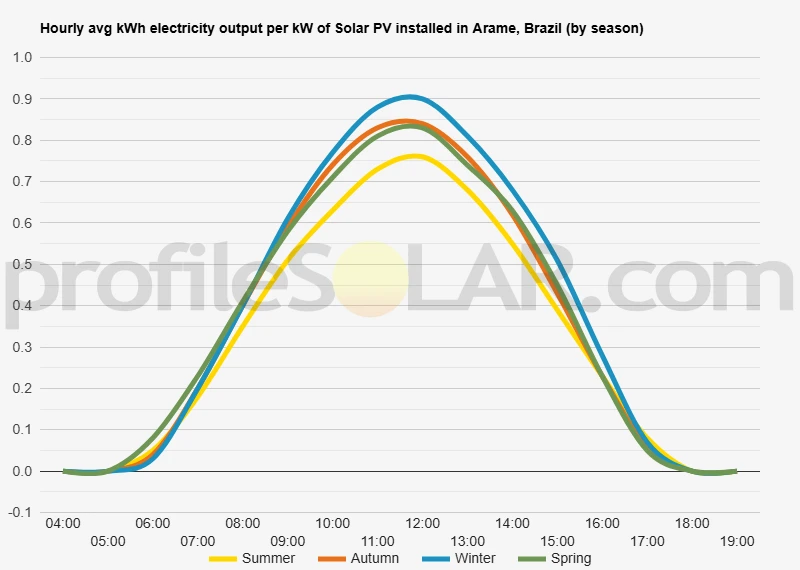
The solar energy output data for Arame demonstrates strong and consistent performance across all seasons. Winter provides the highest energy generation at 6.14 kWh per day per kW of installed solar capacity, followed closely by autumn at 5.75 kWh/day and spring at 5.74 kWh/day. Summer shows the lowest output at 5.12 kWh/day, though this figure still represents excellent solar potential. This seasonal pattern is typical for locations in the Southern Hemisphere tropics, where winter months often provide optimal solar conditions due to clearer skies and the sun's position relative to the location. The relatively small variation between seasons (approximately 20% difference between the highest and lowest months) indicates reliable year-round solar production.Optimal Panel Installation
For fixed solar panel installations in Arame, Maranhão, the ideal tilt angle to maximize total year-round production is 6 degrees facing North. This shallow angle reflects the location's proximity to the equator, where the sun travels high overhead throughout the year. This optimal angle is calculated by analyzing daily solar elevation angles, determining optimal panel positioning, and weighting these factors using solar irradiance data while accounting for Earth's elliptical orbit.Environmental and Weather Challenges
Several environmental factors in Arame could potentially impact solar energy production, though most can be effectively managed through proper installation practices. The tropical climate brings significant rainfall during wet seasons, which can reduce solar output temporarily due to cloud cover and atmospheric moisture. However, rain also provides a natural cleaning mechanism for solar panels, helping to maintain their efficiency by washing away dust and debris. Humidity levels in tropical regions like Arame tend to be consistently high, which can affect electrical components over time. The combination of heat and moisture may accelerate corrosion of metal components and degrade sealing materials more quickly than in drier climates. Dust accumulation during dry periods can reduce panel efficiency, particularly if the area experiences periods of low rainfall. Agricultural activities or unpaved roads in the vicinity could contribute additional dust and particulate matter settling on panel surfaces.Preventative Measures for Optimal Performance
Several installation strategies can help maximize solar energy production in Arame's tropical environment:- Use marine-grade or tropical-rated electrical components and mounting systems specifically designed to resist corrosion in high-humidity environments
- Ensure proper ventilation around panels and electrical equipment to prevent moisture buildup and allow adequate cooling
- Install panels with appropriate drainage to prevent water pooling and ensure quick drying after rainfall
- Implement regular cleaning schedules during dry periods to remove dust accumulation
- Use high-quality sealing and weatherproofing materials rated for tropical conditions
Note: The Tropics are located between 23.5° North and -23.5° South of the equator.
So far, we have conducted calculations to evaluate the solar photovoltaic (PV) potential in 3161 locations across Brazil. This analysis provides insights into each city/location's potential for harnessing solar energy through PV installations.
Link: Solar PV potential in Brazil by location
Solar output per kW of installed solar PV by season in Arame
Seasonal solar PV output for Latitude: -5.0316, Longitude: -45.8632 (Arame, Brazil), based on our analysis of 8760 hourly intervals of solar and meteorological data (one whole year) retrieved for that set of coordinates/location from NASA POWER (The Prediction of Worldwide Energy Resources) API:




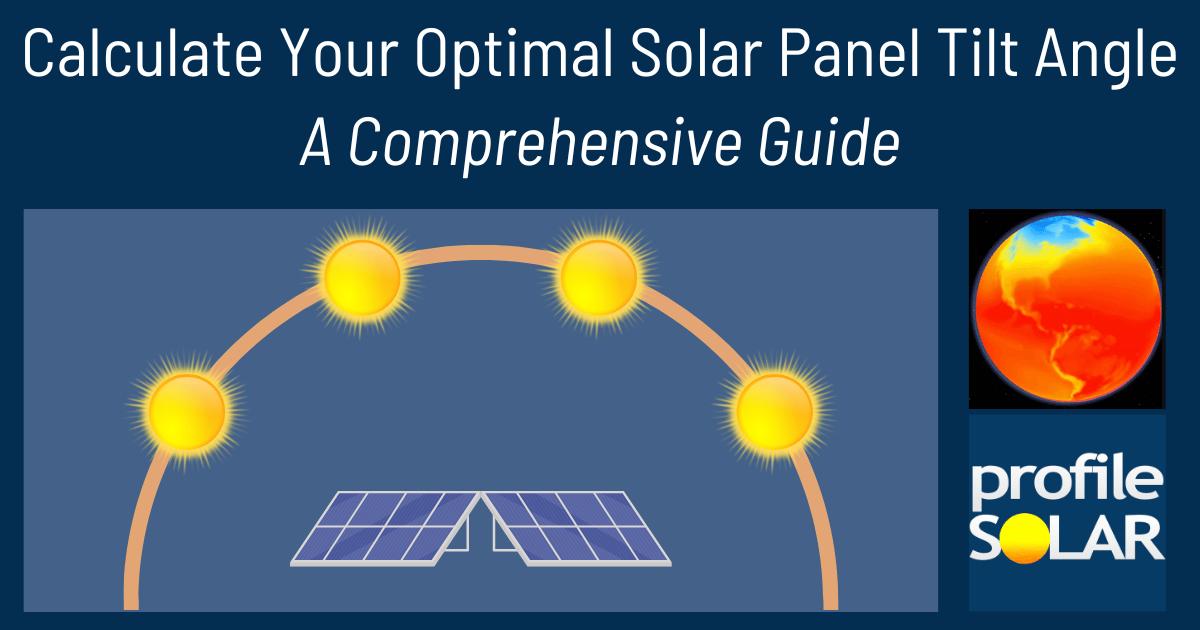
Ideally tilt fixed solar panels 6° North in Arame, Brazil
To maximize your solar PV system's energy output in Arame, Brazil (Lat/Long -5.0316, -45.8632) throughout the year, you should tilt your panels at an angle of 6° North for fixed panel installations.
As the Earth revolves around the Sun each year, the maximum angle of elevation of the Sun varies by +/- 23.45 degrees from its equinox elevation angle for a particular latitude. Finding the exact optimal angle to maximise solar PV production throughout the year can be challenging, but with careful consideration of historical solar energy and meteorological data for a certain location, it can be done precisely.
We use our own calculation, which incorporates NASA solar and meteorological data for the exact Lat/Long coordinates, to determine the ideal tilt angle of a solar panel that will yield maximum annual solar output. We calculate the optimal angle for each day of the year, taking into account its contribution to the yearly total PV potential at that specific location.

Seasonally adjusted solar panel tilt angles for Arame, Brazil
If you can adjust the tilt angle of your solar PV panels, please refer to the seasonal tilt angles below for optimal solar energy production in Arame, Brazil. As mentioned earlier, for fixed-panel solar PV installations, it is optimal to maintain a 6° North tilt angle throughout the year.
| Overall Best Summer Angle | Overall Best Autumn Angle | Overall Best Winter Angle | Overall Best Spring Angle |
|---|---|---|---|
| 11° South in Summer | 12° North in Autumn | 21° North in Winter | 1° South in Spring |
Our recommendations take into account more than just latitude and Earth's position in its elliptical orbit around the Sun. We also incorporate historical solar and meteorological data from NASA's Prediction of Worldwide Energy Resources (POWER) API to assign a weight to each ideal angle for each day based on its historical contribution to overall solar PV potential during a specific season.
This approach allows us to provide much more accurate recommendations than relying solely on latitude, as it considers unique weather conditions in different locations sharing the same latitude worldwide.
Calculate solar panel row spacing in Arame, Brazil
We've added a feature to calculate minimum solar panel row spacing by location. Enter your panel size and orientation below to get the minimum spacing in Arame, Brazil.
Our calculation method
- Solar Position:
We determine the Sun's position on the Winter solstice using the location's latitude and solar declination. - Shadow Projection:
We calculate the shadow length cast by panels using trigonometry, considering panel tilt and the Sun's elevation angle. - Minimum Spacing:
We add the shadow length to the horizontal space occupied by tilted panels.
This approach ensures maximum space efficiency while avoiding shading during critical times, as the Winter solstice represents the worst-case scenario for shadow length.
Topography for solar PV around Arame, Brazil
Topographical Characteristics of Arame, Brazil
Arame is situated in the state of Maranhão, Brazil, within a region characterized by gently rolling terrain and relatively modest elevation changes. The landscape around this municipality features predominantly flat to undulating topography, with elevations typically ranging from 200 to 400 meters above sea level. The area sits within the transition zone between the Amazon Basin to the west and the Brazilian Highlands to the east, creating a distinctive geographical setting.
The terrain consists primarily of low hills and broad valleys, with gentle slopes that rarely exceed significant gradients. This topographical configuration results from the underlying geological formations of sedimentary rocks and ancient crystalline basement structures. The landscape is punctuated by numerous small streams and seasonal watercourses that drain toward larger river systems, creating subtle depressions and ridgelines across the region.
Vegetation in the area reflects the transitional nature of the landscape, with patches of cerrado savanna interspersed with gallery forests along waterways and remnants of tropical forest on higher ground. The relatively open nature of much of the terrain, combined with the moderate relief, creates extensive areas of accessible land with good visibility and minimal natural obstructions.
Optimal Areas for Large-Scale Solar Development
The most suitable locations for large-scale solar photovoltaic installations around Arame would be the elevated plateaus and gentle hillsides that characterize much of the surrounding landscape. These areas offer several advantages for solar development, including naturally well-drained terrain that reduces flooding risks and provides stable foundations for solar panel arrays.
The broad, gently sloping areas to the northeast and southeast of Arame present particularly favorable conditions. These locations feature minimal tree cover, relatively uniform topography, and good accessibility via existing rural roads. The gentle southern-facing slopes in these areas would be especially beneficial for optimizing solar panel orientation and minimizing shading issues between panel rows.
Areas of cleared or naturally sparse vegetation on the higher elevations around the municipality would also be well-suited for solar development. These locations typically experience better air circulation, which helps maintain optimal operating temperatures for solar equipment. The elevated positions also tend to have fewer issues with fog or low-lying moisture that can affect solar panel efficiency.
The flatter valley floors, while seemingly attractive for their ease of construction, may be less ideal due to potential drainage issues during the rainy season and the possibility of morning fog accumulation. However, the larger cleared areas in these zones could still be viable with proper site preparation and drainage systems.
Brazil solar PV Stats as a country
Brazil ranks 13th in the world for cumulative solar PV capacity, with 13,708 total MW's of solar PV installed. This means that 2.50% of Brazil's total energy as a country comes from solar PV (that's 31st in the world). Each year Brazil is generating 64 Watts from solar PV per capita (Brazil ranks 47th in the world for solar PV Watts generated per capita). [source]
Are there incentives for businesses to install solar in Brazil?
Yes, there are several incentives for businesses wanting to install solar energy in Brazil. The Brazilian government offers a range of tax credits and other financial incentives to encourage the adoption of renewable energy sources such as solar power. These include reduced import taxes on solar equipment, accelerated depreciation of investments in renewable energy projects, and preferential financing from public banks. Additionally, some states offer additional incentives such as subsidies or grants for businesses that install solar systems.
Do you have more up to date information than this on incentives towards solar PV projects in Brazil? Please reach out to us and help us keep this information current. Thanks!
Citation Guide
Article Details for Citation
Author: Aaron Robinson
Publisher: profileSOLAR.com
First Published: Tuesday 15th of July 2025
Last Updated: Wednesday 6th of August 2025
Tell Us About Your Work
We love seeing how our research helps others! If you've cited this article in your work, we'd be delighted to hear about it. Drop us a line via our Contact Us page or on X, to share where you've used our information - we may feature a link to your work on our site. This helps create a network of valuable resources for others in the solar energy community and helps us understand how our research is contributing to the field. Plus, we occasionally highlight exceptional works that reference our research on our social media channels.
Feeling generous?

Share this with your friends!


Compare this location to others worldwide for solar PV potential
The solar PV analyses available on our website, including this one, are offered as a free service to the global community. Our aim is to provide education and aid informed decision-making regarding solar PV installations.
However, please note that these analyses are general guidance and may not meet specific project requirements. For in-depth, tailored forecasts and analysis crucial for feasibility studies or when pursuing maximum ROI from your solar projects, feel free to contact us; we offer comprehensive consulting services expressly for this purpose.

Helping you assess viability of solar PV for your site
Calculate Your Optimal Solar Panel Tilt Angle: A Comprehensive Guide
Enhance your solar panel's performance with our in-depth guide. Determine the best tilt angle using hard data, debunk common misunderstandings, and gain insight into how your specific location affects solar energy production.