 Solar PV Analysis of Itapema, Brazil
Itapema, Santa Catarina, Brazil, located in the Southern Sub Tropics at latitude -27.1068 and longitude -48.6265, offers a reasonably good location for solar PV energy generation throughout the year, though with significant seasonal variations.
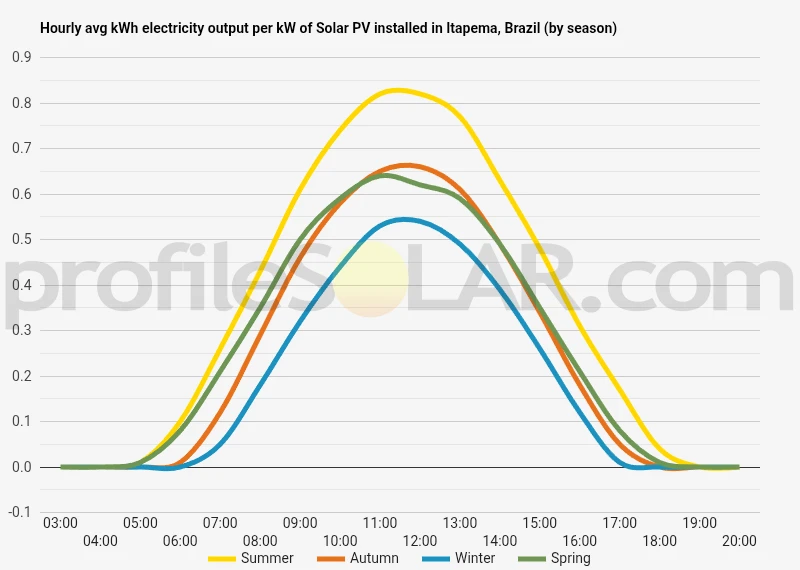
The solar energy production in Itapema follows a predictable seasonal pattern. Summer brings the highest production at 6.18kWh per day for each kilowatt of installed capacity. Spring follows as the second most productive season with 4.73kWh/day, while autumn yields 4.46kWh/day. Winter shows the lowest production at 3.32kWh/day per kilowatt of installed capacity.
Optimal Panel Installation
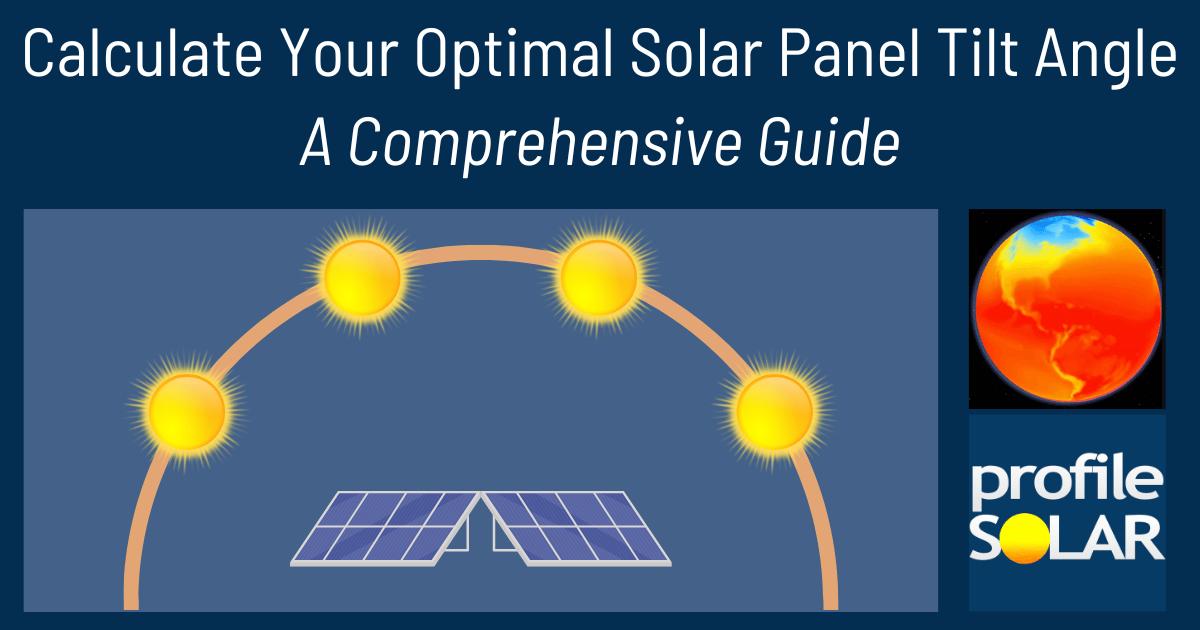
For fixed solar panel installations in Itapema, Santa Catarina, the ideal tilt angle to maximize year-round energy production is 24 degrees facing North. This angle has been calculated taking into account the location's latitude and the weighted solar potential throughout the year.
Environmental and Weather Considerations
Several factors may affect solar production in Itapema that should be considered when planning an installation:
- Coastal humidity and salt exposure can degrade solar equipment over time, requiring marine-grade components and regular maintenance
- Summer thunderstorms may temporarily reduce production and potentially damage equipment if not properly protected
- Occasional winter fog along the coast can reduce morning production
- Tree shading could be an issue in this subtropical region with lush vegetation
To mitigate these challenges, installations should include surge protection systems, regular cleaning protocols to remove salt deposits, elevated mounting to avoid vegetation shading, and potentially micro-inverters or power optimizers to minimize the impact of partial shading.
Overall, Itapema provides good conditions for solar energy generation, particularly from late spring through early autumn. The significant drop in winter production (about 46% less than summer) means system sizing should account for these seasonal variations if year-round self-sufficiency is desired.
Note: The Southern Sub Tropics extend from -23.5° latitude South down to -35° latitude.
So far, we have conducted calculations to evaluate the solar photovoltaic (PV) potential in 3161 locations across Brazil. This analysis provides insights into each city/location's potential for harnessing solar energy through PV installations.
Link: Solar PV potential in Brazil by location
Solar output per kW of installed solar PV by season in Itapema
Seasonal solar PV output for Latitude: -27.1068, Longitude: -48.6265 (Itapema, Brazil), based on our analysis of 8760 hourly intervals of solar and meteorological data (one whole year) retrieved for that set of coordinates/location from NASA POWER (The Prediction of Worldwide Energy Resources) API:




Ideally tilt fixed solar panels 24° North in Itapema, Brazil
To maximize your solar PV system's energy output in Itapema, Brazil (Lat/Long -27.1068, -48.6265) throughout the year, you should tilt your panels at an angle of 24° North for fixed panel installations.
As the Earth revolves around the Sun each year, the maximum angle of elevation of the Sun varies by +/- 23.45 degrees from its equinox elevation angle for a particular latitude. Finding the exact optimal angle to maximise solar PV production throughout the year can be challenging, but with careful consideration of historical solar energy and meteorological data for a certain location, it can be done precisely.
We use our own calculation, which incorporates NASA solar and meteorological data for the exact Lat/Long coordinates, to determine the ideal tilt angle of a solar panel that will yield maximum annual solar output. We calculate the optimal angle for each day of the year, taking into account its contribution to the yearly total PV potential at that specific location.

Seasonally adjusted solar panel tilt angles for Itapema, Brazil
If you can adjust the tilt angle of your solar PV panels, please refer to the seasonal tilt angles below for optimal solar energy production in Itapema, Brazil. As mentioned earlier, for fixed-panel solar PV installations, it is optimal to maintain a 24° North tilt angle throughout the year.
| Overall Best Summer Angle | Overall Best Autumn Angle | Overall Best Winter Angle | Overall Best Spring Angle |
|---|---|---|---|
| 11° North in Summer | 33° North in Autumn | 43° North in Winter | 20° North in Spring |
Our recommendations take into account more than just latitude and Earth's position in its elliptical orbit around the Sun. We also incorporate historical solar and meteorological data from NASA's Prediction of Worldwide Energy Resources (POWER) API to assign a weight to each ideal angle for each day based on its historical contribution to overall solar PV potential during a specific season.
This approach allows us to provide much more accurate recommendations than relying solely on latitude, as it considers unique weather conditions in different locations sharing the same latitude worldwide.
Calculate solar panel row spacing in Itapema, Brazil
We've added a feature to calculate minimum solar panel row spacing by location. Enter your panel size and orientation below to get the minimum spacing in Itapema, Brazil.
Our calculation method
- Solar Position:
We determine the Sun's position on the Winter solstice using the location's latitude and solar declination. - Shadow Projection:
We calculate the shadow length cast by panels using trigonometry, considering panel tilt and the Sun's elevation angle. - Minimum Spacing:
We add the shadow length to the horizontal space occupied by tilted panels.
This approach ensures maximum space efficiency while avoiding shading during critical times, as the Winter solstice represents the worst-case scenario for shadow length.
Topography for solar PV around Itapema, Brazil
Itapema is a coastal city nestled in the state of Santa Catarina, southern Brazil. The topographical landscape of Itapema and its surrounding areas is characterized by a striking blend of Atlantic coastal plains and the impressive Serra do Mar mountain range. This mountainous backdrop rises dramatically from the coastal plains, creating a distinctive topographical profile that influences the region's climate, vegetation, and development patterns. The coastal zone of Itapema features relatively flat sandy beaches and lowlands that gradually give way to increasingly elevated terrain as one moves inland. The transition from coastal plain to foothills is relatively rapid, with elevation increasing noticeably within just a few kilometers from the shoreline. This coastal strip is narrow compared to many other Brazilian coastal regions, constrained by the proximity of the mountains to the sea.
Mountain Features and Inland Topography
The Serra do Mar mountain range dominates the inland areas, with numerous hills, valleys, and slopes characterizing the landscape. These mountains are part of the larger Great Escarpment that runs along much of Brazil's southeastern coast. In the Itapema region, these mountains typically reach elevations of 600-900 meters, though some peaks in the broader region exceed 1,000 meters. The mountainous terrain is dissected by numerous river valleys and streams flowing toward the Atlantic Ocean, creating a complex network of watersheds. These waterways have carved distinctive valleys through the landscape over geological time, resulting in varied topographical features including steep slopes, gentler hillsides, and narrow valley bottoms.Vegetation and Land Cover
The natural vegetation of the region reflects this topographical diversity. The area falls within the Atlantic Forest (Mata Atlântica) biome, one of the most biodiverse yet threatened forest systems in the world. Lower elevations typically feature coastal vegetation adapted to sandy soils, while the hillsides and mountains support more dense forest coverage where not cleared for human use. Much of the original forest cover has been modified by human activity, particularly in the more accessible coastal plains and lower foothills. Agricultural land, urban development, and secondary forest growth now characterize significant portions of the landscape.Solar PV Potential Areas
For large-scale solar photovoltaic (PV) installations, several factors related to topography must be considered. The most suitable areas near Itapema would generally include: The coastal plains offer relatively flat terrain that would minimize site preparation costs for solar installations. However, these areas face competition from urban development, tourism infrastructure, and higher land values due to proximity to the coast. Gently sloping foothills with southern Santa Catarina's favorable solar radiation conditions present promising opportunities. These areas, located where the coastal plain begins to rise toward the Serra do Mar but before the terrain becomes too steep, offer a good balance of available land and suitable topography. Elevated plateaus or broader valley areas within the mountain region might offer suitable locations, particularly those with favorable orientation toward the north (for maximum solar exposure in the Southern Hemisphere). However, accessibility and grid connection challenges increase with distance from established infrastructure. The municipalities surrounding Itapema, such as Balneário Camboriú, Camboriú, and Porto Belo, contain varying proportions of these topographical features. The broader inland regions toward Brusque and the Itajaí Valley offer more extensive areas of gentler terrain that might accommodate larger solar installations.Topographical Challenges
The mountainous nature of much of the region does present certain challenges for large-scale solar development. Steep slopes are generally unsuitable for large solar arrays due to installation difficulties, potential soil stability issues, and uneven solar exposure. The region's numerous water courses and drainage patterns must also be considered in site selection to avoid flood-prone areas and minimize environmental impacts. Additionally, the Atlantic Forest ecosystem, even in its fragmented state, represents an important ecological resource. Solar development would ideally focus on already disturbed or cleared lands rather than requiring further deforestation of remaining natural areas. In conclusion, while Itapema's immediate surroundings feature challenging topography due to the proximity of mountains to the coast, the broader region does offer potential areas for solar PV development, particularly in the transition zones between coastal plains and steeper mountain slopes, and in the more gently rolling terrain found further inland.Brazil solar PV Stats as a country
Brazil ranks 13th in the world for cumulative solar PV capacity, with 13,708 total MW's of solar PV installed. This means that 2.50% of Brazil's total energy as a country comes from solar PV (that's 31st in the world). Each year Brazil is generating 64 Watts from solar PV per capita (Brazil ranks 47th in the world for solar PV Watts generated per capita). [source]
Are there incentives for businesses to install solar in Brazil?
Yes, there are several incentives for businesses wanting to install solar energy in Brazil. The Brazilian government offers a range of tax credits and other financial incentives to encourage the adoption of renewable energy sources such as solar power. These include reduced import taxes on solar equipment, accelerated depreciation of investments in renewable energy projects, and preferential financing from public banks. Additionally, some states offer additional incentives such as subsidies or grants for businesses that install solar systems.
Do you have more up to date information than this on incentives towards solar PV projects in Brazil? Please reach out to us and help us keep this information current. Thanks!
Citation Guide
Article Details for Citation
Author: Aaron Robinson
Publisher: profileSOLAR.com
First Published: Saturday 28th of June 2025
Last Updated: Monday 21st of July 2025
Tell Us About Your Work
We love seeing how our research helps others! If you've cited this article in your work, we'd be delighted to hear about it. Drop us a line via our Contact Us page or on X, to share where you've used our information - we may feature a link to your work on our site. This helps create a network of valuable resources for others in the solar energy community and helps us understand how our research is contributing to the field. Plus, we occasionally highlight exceptional works that reference our research on our social media channels.
Feeling generous?

Share this with your friends!


Compare this location to others worldwide for solar PV potential
The solar PV analyses available on our website, including this one, are offered as a free service to the global community. Our aim is to provide education and aid informed decision-making regarding solar PV installations.
However, please note that these analyses are general guidance and may not meet specific project requirements. For in-depth, tailored forecasts and analysis crucial for feasibility studies or when pursuing maximum ROI from your solar projects, feel free to contact us; we offer comprehensive consulting services expressly for this purpose.

Helping you assess viability of solar PV for your site
Calculate Your Optimal Solar Panel Tilt Angle: A Comprehensive Guide
Enhance your solar panel's performance with our in-depth guide. Determine the best tilt angle using hard data, debunk common misunderstandings, and gain insight into how your specific location affects solar energy production.