.svg) Solar PV Analysis of Mount Forest, Canada
Solar PV Analysis of Mount Forest, Canada
Mount Forest, Ontario, Canada is a moderately suitable location for year-round solar energy generation, though it experiences significant seasonal variations typical of the Northern Temperate Zone climate.
Seasonal Solar Performance
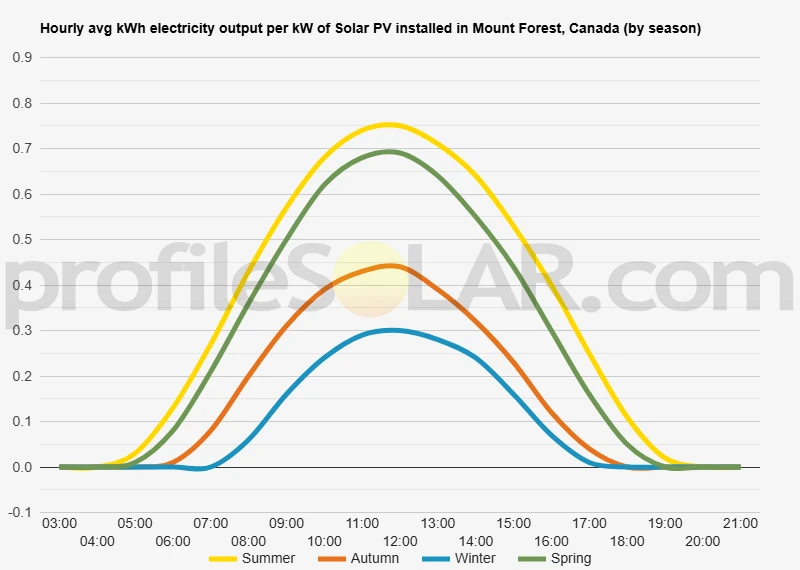
The solar energy output at Mount Forest varies dramatically throughout the year. Summer provides the peak generation period with 6.26 kWh per day per kW of installed solar capacity, making it an excellent time for solar production. Spring follows as the second-best season with 5.30 kWh per day per kW, offering strong solar potential as daylight hours increase and weather improves. Autumn sees a notable decline to 2.97 kWh per day per kW as the region transitions toward winter conditions. Winter presents the most challenging period for solar generation, producing only 1.81 kWh per day per kW of installed capacity, which is less than one-third of summer output. For optimal year-round performance at this location, solar panels should be installed at a fixed tilt angle of 37 degrees facing south. This angle maximizes total annual energy production by accounting for the sun's changing position throughout the seasons.Environmental and Weather Challenges
Several local factors can significantly impact solar energy production in Mount Forest:- Snow accumulation during winter months can completely block solar panels
- Ice formation can reduce panel efficiency and create safety hazards
- Frequent cloud cover during autumn and winter reduces solar irradiance
- Temperature fluctuations can cause thermal stress on equipment
Installation Solutions
Property owners can take several preventative measures to maximize solar production despite these challenges. Installing panels at the recommended 37-degree tilt helps snow slide off more easily, reducing accumulation problems. Adding heating elements or snow guards can further prevent ice and snow buildup during harsh winter conditions. Choosing high-quality panels rated for extreme temperature variations ensures better performance during Mount Forest's variable climate. Regular maintenance schedules should include snow removal and debris cleaning, particularly during the transition seasons when falling leaves and other organic matter can accumulate on panel surfaces. Proper spacing between panel rows prevents shading issues, which become more critical during winter when the sun sits lower in the sky. Installing a monitoring system allows owners to quickly identify and address any performance issues caused by environmental factors.Note: The Northern Temperate Zone extends from 35° latitude North up to 66.5° latitude.
So far, we have conducted calculations to evaluate the solar photovoltaic (PV) potential in 569 locations across Canada. This analysis provides insights into each city/location's potential for harnessing solar energy through PV installations.
Link: Solar PV potential in Canada by location
Solar output per kW of installed solar PV by season in Mount Forest
Seasonal solar PV output for Latitude: 43.9796, Longitude: -80.7231 (Mount Forest, Canada), based on our analysis of 8760 hourly intervals of solar and meteorological data (one whole year) retrieved for that set of coordinates/location from NASA POWER (The Prediction of Worldwide Energy Resources) API:




Ideally tilt fixed solar panels 37° South in Mount Forest, Canada
To maximize your solar PV system's energy output in Mount Forest, Canada (Lat/Long 43.9796, -80.7231) throughout the year, you should tilt your panels at an angle of 37° South for fixed panel installations.
As the Earth revolves around the Sun each year, the maximum angle of elevation of the Sun varies by +/- 23.45 degrees from its equinox elevation angle for a particular latitude. Finding the exact optimal angle to maximise solar PV production throughout the year can be challenging, but with careful consideration of historical solar energy and meteorological data for a certain location, it can be done precisely.
We use our own calculation, which incorporates NASA solar and meteorological data for the exact Lat/Long coordinates, to determine the ideal tilt angle of a solar panel that will yield maximum annual solar output. We calculate the optimal angle for each day of the year, taking into account its contribution to the yearly total PV potential at that specific location.

Seasonally adjusted solar panel tilt angles for Mount Forest, Canada
If you can adjust the tilt angle of your solar PV panels, please refer to the seasonal tilt angles below for optimal solar energy production in Mount Forest, Canada. As mentioned earlier, for fixed-panel solar PV installations, it is optimal to maintain a 37° South tilt angle throughout the year.
| Overall Best Summer Angle | Overall Best Autumn Angle | Overall Best Winter Angle | Overall Best Spring Angle |
|---|---|---|---|
| 28° South in Summer | 47° South in Autumn | 58° South in Winter | 37° South in Spring |
Our recommendations take into account more than just latitude and Earth's position in its elliptical orbit around the Sun. We also incorporate historical solar and meteorological data from NASA's Prediction of Worldwide Energy Resources (POWER) API to assign a weight to each ideal angle for each day based on its historical contribution to overall solar PV potential during a specific season.
This approach allows us to provide much more accurate recommendations than relying solely on latitude, as it considers unique weather conditions in different locations sharing the same latitude worldwide.
Calculate solar panel row spacing in Mount Forest, Canada
We've added a feature to calculate minimum solar panel row spacing by location. Enter your panel size and orientation below to get the minimum spacing in Mount Forest, Canada.
Our calculation method
- Solar Position:
We determine the Sun's position on the Winter solstice using the location's latitude and solar declination. - Shadow Projection:
We calculate the shadow length cast by panels using trigonometry, considering panel tilt and the Sun's elevation angle. - Minimum Spacing:
We add the shadow length to the horizontal space occupied by tilted panels.
This approach ensures maximum space efficiency while avoiding shading during critical times, as the Winter solstice represents the worst-case scenario for shadow length.
Topography for solar PV around Mount Forest, Canada
Topographical Characteristics of Mount Forest
Mount Forest sits in the heart of Wellington County, Ontario, positioned within the gently rolling landscape that characterizes much of southwestern Ontario's agricultural heartland. The terrain around this community features predominantly flat to gently undulating farmland, with elevation changes that are generally modest and gradual rather than dramatic. The area forms part of the broader physiographic region known as the Southern Ontario Plain, which extends across much of the province's most densely populated and agriculturally productive areas. The landscape immediately surrounding Mount Forest consists primarily of cleared agricultural land interspersed with woodlots and small forested areas. The topography slopes very gently, creating natural drainage patterns that flow toward the Saugeen River system to the west and the Grand River watershed to the east. These subtle elevation changes rarely present significant obstacles to development or infrastructure projects, making the region particularly suitable for various land uses.Drainage and Land Features
The local drainage network includes several small creeks and tributaries that meander through the relatively flat terrain. These waterways have carved gentle valleys over time, but the relief remains modest throughout the area. The soil composition consists largely of fertile clay loam and sandy loam deposits left behind by glacial activity, which explains the region's strong agricultural heritage and the prevalence of crop production and livestock farming. Small patches of mixed hardwood forest dot the landscape, particularly along creek valleys and property boundaries, but the majority of the land has been cleared for agricultural purposes over the past century and a half. This clearing has created an open, expansive landscape with excellent exposure to prevailing weather patterns and minimal natural obstructions to sunlight.Optimal Areas for Large-Scale Solar Development
The flat to gently rolling agricultural lands extending south and southwest of Mount Forest present the most favorable conditions for large-scale solar photovoltaic installations. These areas offer several key advantages including minimal slope variations that would complicate panel installation, excellent southern exposure without significant shading from hills or dense forest cover, and existing agricultural land that could potentially be converted or shared with solar infrastructure. The open farmland stretching toward the communities of Arthur and Drayton provides particularly suitable terrain, with large contiguous parcels of relatively flat land and good access to existing electrical transmission infrastructure. The gentle southward slope of much of this terrain naturally optimizes solar panel orientation while ensuring proper drainage around installations. Areas to the east and southeast of Mount Forest, toward Fergus and Elora, also present good opportunities despite slightly more varied topography. While this region features more pronounced river valleys carved by the Grand River system, the upland areas between these valleys remain relatively flat and well-suited to solar development. The proximity to larger population centers in this direction also provides advantages for electrical grid connection and power distribution.Topographical Considerations for Solar Siting
The minimal elevation changes throughout the Mount Forest region mean that issues related to steep slopes, difficult access, or complex grading requirements are rarely significant concerns for solar development. However, developers should pay attention to the subtle drainage patterns created by the gentle topographical variations to ensure proper water management around solar installations. The scattered woodlots and tree lines that break up the agricultural landscape can create localized shading concerns, but these features are generally small enough and sufficiently spaced that they would not significantly impact large-scale solar projects with proper siting. The prevailing flat terrain allows for flexible facility design and layout optimization to work around any such obstacles while maintaining efficient land use.Canada solar PV Stats as a country
Canada ranks 23rd in the world for cumulative solar PV capacity, with 3,630 total MW's of solar PV installed. This means that 0.70% of Canada's total energy as a country comes from solar PV (that's 38th in the world). Each year Canada is generating 96 Watts from solar PV per capita (Canada ranks 40th in the world for solar PV Watts generated per capita). [source]
Are there incentives for businesses to install solar in Canada?
There are several incentives for businesses to install solar power systems in Canada. These incentives vary by province and can include:
1. Federal Tax Incentives:- Accelerated Capital Cost Allowance (CCA): Businesses can write off the full cost of clean energy equipment in the year it's put into use.
- Ontario: Save on Energy program offers incentives for businesses to reduce energy consumption.
- Alberta: Energy Efficiency Alberta offers rebates for solar PV installations.
- British Columbia: BC Hydro offers a net metering program. BC Hydro also offers rebates for solar panels and battery storage.
- Nova Scotia: Solar Electricity for Community Buildings Program.
Many provinces ofer net metering, allowing businesses to sell excess electricity back to the grid.
4. Grants and Loans:Some provinces offer grants or low-interest loans for renewable energy projects.
5. Carbon Pricing:The federal carbon pricing system can make solar more competitive compared to fossil fuels.
6. Municipal Incentives:Some cities offer additional incentives or property tax reductions for solar installations.
7. Reduced Operating Costs:While not a direct incentive, businesses can significantly reduce their long-term energy costs.
Note: Incentives and programs can change over time, so businesses should check with local authorities and energy providers for the most up-to-date information.
Do you have more up to date information than this on incentives towards solar PV projects in Canada? Please reach out to us and help us keep this information current. Thanks!
Citation Guide
Article Details for Citation
Author: Aaron Robinson
Publisher: profileSOLAR.com
First Published: Wednesday 23rd of July 2025
Last Updated: Thursday 7th of August 2025
Tell Us About Your Work
We love seeing how our research helps others! If you've cited this article in your work, we'd be delighted to hear about it. Drop us a line via our Contact Us page or on X, to share where you've used our information - we may feature a link to your work on our site. This helps create a network of valuable resources for others in the solar energy community and helps us understand how our research is contributing to the field. Plus, we occasionally highlight exceptional works that reference our research on our social media channels.
Feeling generous?

Share this with your friends!


Compare this location to others worldwide for solar PV potential
The solar PV analyses available on our website, including this one, are offered as a free service to the global community. Our aim is to provide education and aid informed decision-making regarding solar PV installations.
However, please note that these analyses are general guidance and may not meet specific project requirements. For in-depth, tailored forecasts and analysis crucial for feasibility studies or when pursuing maximum ROI from your solar projects, feel free to contact us; we offer comprehensive consulting services expressly for this purpose.

Helping you assess viability of solar PV for your site
Calculate Your Optimal Solar Panel Tilt Angle: A Comprehensive Guide
Enhance your solar panel's performance with our in-depth guide. Determine the best tilt angle using hard data, debunk common misunderstandings, and gain insight into how your specific location affects solar energy production.