 Solar PV Analysis of Minya, Egypt
Minya, Egypt, situated in the Northern Sub Tropics at coordinates 28.0907, 30.7566, offers excellent conditions for solar PV energy generation. This location experiences strong solar energy potential throughout the year, with varying output across different seasons.
Seasonal Solar Performance
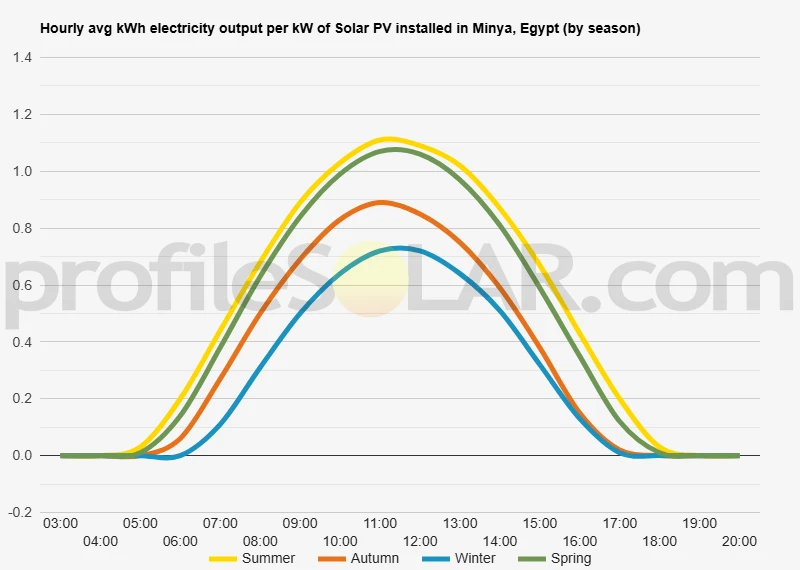
Solar panels in Minya demonstrate impressive performance year-round, with notable seasonal variations. Summer stands out as the most productive season, generating approximately 8.69kWh per day for each kilowatt of installed capacity. Spring follows closely behind with 7.99kWh/day. Production decreases in autumn to 5.97kWh/day, with winter being the least productive season at 4.60kWh/day per kilowatt installed.
The substantial difference between summer and winter production (nearly double) reflects the typical seasonal pattern for the region, but even winter production remains quite favorable compared to many global locations. This consistent performance makes Minya an attractive location for solar investment with reliable energy generation throughout the year.
Optimal Installation Configuration
For fixed solar panel installations in Minya, the ideal tilt angle to maximize year-round energy production is 24 degrees facing South. This specific angle has been calculated by analyzing daily solar elevation patterns at this latitude, weighted by the solar potential throughout the year. This optimized angle ensures the best possible annual energy harvest from a static installation.
Environmental Considerations
Despite Minya's excellent solar potential, several environmental factors require consideration for optimal installation:
- Dust and sand accumulation presents a significant challenge in this desert region, potentially reducing panel efficiency by 10-40% if not addressed. Regular cleaning protocols and dust-resistant panel coatings are highly recommended.
- High summer temperatures (frequently exceeding 40°C/104°F) can reduce panel efficiency. Installations should incorporate adequate airflow beneath panels and potentially use temperature-tolerant panel technologies.
- Though infrequent, sandstorms can cause abrasion damage to panels and temporary production drops. Protective measures such as automatic tilt systems that can position panels vertically during storms can help mitigate damage.
With proper planning for these environmental factors, Minya's exceptional solar resource can be harnessed effectively. The combination of high annual solar radiation and relatively mild winters makes this location particularly well-suited for large-scale solar PV deployment, with only minimal seasonal adjustments needed to maintain optimal production.
Note: The Northern Sub Tropics extend from 23.5° latitude North up to 35° latitude.
So far, we have conducted calculations to evaluate the solar photovoltaic (PV) potential in 80 locations across Egypt. This analysis provides insights into each city/location's potential for harnessing solar energy through PV installations.
Link: Solar PV potential in Egypt by location
Solar output per kW of installed solar PV by season in Minya
Seasonal solar PV output for Latitude: 28.0907, Longitude: 30.7566 (Minya, Egypt), based on our analysis of 8760 hourly intervals of solar and meteorological data (one whole year) retrieved for that set of coordinates/location from NASA POWER (The Prediction of Worldwide Energy Resources) API:




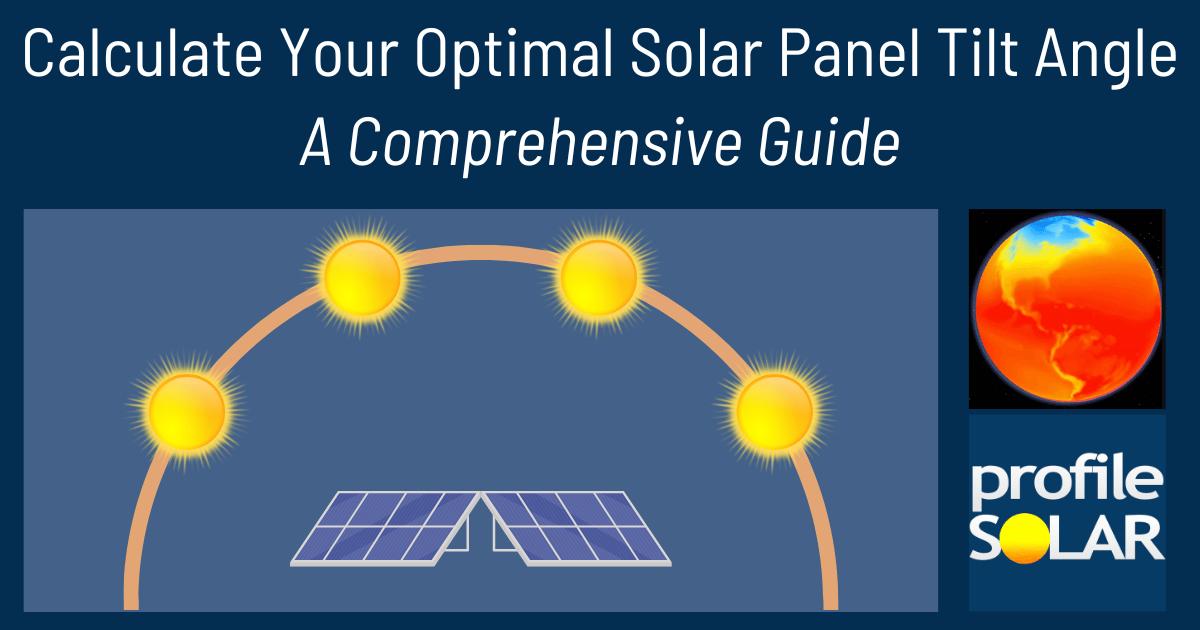
Ideally tilt fixed solar panels 24° South in Minya, Egypt
To maximize your solar PV system's energy output in Minya, Egypt (Lat/Long 28.0907, 30.7566) throughout the year, you should tilt your panels at an angle of 24° South for fixed panel installations.
As the Earth revolves around the Sun each year, the maximum angle of elevation of the Sun varies by +/- 23.45 degrees from its equinox elevation angle for a particular latitude. Finding the exact optimal angle to maximise solar PV production throughout the year can be challenging, but with careful consideration of historical solar energy and meteorological data for a certain location, it can be done precisely.
We use our own calculation, which incorporates NASA solar and meteorological data for the exact Lat/Long coordinates, to determine the ideal tilt angle of a solar panel that will yield maximum annual solar output. We calculate the optimal angle for each day of the year, taking into account its contribution to the yearly total PV potential at that specific location.

Seasonally adjusted solar panel tilt angles for Minya, Egypt
If you can adjust the tilt angle of your solar PV panels, please refer to the seasonal tilt angles below for optimal solar energy production in Minya, Egypt. As mentioned earlier, for fixed-panel solar PV installations, it is optimal to maintain a 24° South tilt angle throughout the year.
| Overall Best Summer Angle | Overall Best Autumn Angle | Overall Best Winter Angle | Overall Best Spring Angle |
|---|---|---|---|
| 12° South in Summer | 33° South in Autumn | 43° South in Winter | 21° South in Spring |
Our recommendations take into account more than just latitude and Earth's position in its elliptical orbit around the Sun. We also incorporate historical solar and meteorological data from NASA's Prediction of Worldwide Energy Resources (POWER) API to assign a weight to each ideal angle for each day based on its historical contribution to overall solar PV potential during a specific season.
This approach allows us to provide much more accurate recommendations than relying solely on latitude, as it considers unique weather conditions in different locations sharing the same latitude worldwide.
Calculate solar panel row spacing in Minya, Egypt
We've added a feature to calculate minimum solar panel row spacing by location. Enter your panel size and orientation below to get the minimum spacing in Minya, Egypt.
Our calculation method
- Solar Position:
We determine the Sun's position on the Winter solstice using the location's latitude and solar declination. - Shadow Projection:
We calculate the shadow length cast by panels using trigonometry, considering panel tilt and the Sun's elevation angle. - Minimum Spacing:
We add the shadow length to the horizontal space occupied by tilted panels.
This approach ensures maximum space efficiency while avoiding shading during critical times, as the Winter solstice represents the worst-case scenario for shadow length.
Topography for solar PV around Minya, Egypt
The terrain surrounding Minya, Egypt, situated at approximately 28.0907°N, 30.7566°E, is characterized by a diverse topographical profile that reflects the region's position within the Nile Valley. Minya sits on the western bank of the Nile River, which flows northward through a relatively flat alluvial plain. This fertile valley, created by millennia of Nile flooding cycles, ranges from 3 to 10 kilometers in width in this section and features rich agricultural land that has sustained civilization for thousands of years. To the east of the Nile, the landscape rises gradually into the Eastern Desert (also known as the Arabian Desert), presenting limestone plateaus and scattered hills that eventually merge with more significant mountain formations further east. The transition from river valley to desert is fairly abrupt, with elevation increasing noticeably within just a few kilometers of the river's edge. The western side of Minya presents a more dramatic topographical contrast. The Western Desert (part of the vast Sahara) begins almost immediately west of the cultivated Nile Valley lands. This area features expansive flat or gently undulating desert plains interspersed with occasional depressions, some of which form oases where groundwater reaches the surface. The land gradually rises into limestone plateaus with escarpments that can reach 200-300 meters above the valley floor.
Solar PV Potential Areas
For large-scale solar photovoltaic installations, the desert regions surrounding Minya offer exceptional potential. The most suitable areas would be the desert plains of the Western Desert, beginning approximately 5-10 kilometers west of Minya city. These areas combine several advantageous characteristics for solar development: The flat to gently sloping desert terrain requires minimal land preparation, reducing construction costs and environmental disruption. The limestone plateau areas provide stable foundation conditions for solar infrastructure. Additionally, these western desert regions receive minimal cloud cover throughout the year, maximizing solar exposure. The Eastern Desert areas also present viable options for solar development, though the terrain tends to be more variable with scattered hills and wadis (dry riverbeds). The areas approximately 10-15 kilometers east of the Nile maintain relatively flat profiles suitable for large installations. Both eastern and western desert regions benefit from minimal competing land uses, as they are generally unsuitable for agriculture without significant irrigation infrastructure. The proximity to Minya city and existing infrastructure corridors along the Nile Valley provides potential connection points to the electrical grid, though extension infrastructure would be required to reach the optimal desert locations. It's worth noting that while the immediate Nile Valley lands receive abundant sunshine, these fertile areas are primarily dedicated to essential agricultural production and human settlement, making them less appropriate for large-scale solar development compared to the abundant desert lands that surround them.Egypt solar PV Stats as a country
Egypt ranks 34th in the world for cumulative solar PV capacity, with 1,675 total MW's of solar PV installed. Each year Egypt is generating 17 Watts from solar PV per capita (Egypt ranks 67th in the world for solar PV Watts generated per capita). [source]
Are there incentives for businesses to install solar in Egypt?
Yes, there are incentives for businesses wanting to install solar energy in Egypt. The Egyptian government has implemented a number of policies and programs to encourage the adoption of renewable energy sources such as solar power. These include feed-in tariffs, net metering, tax exemptions, and subsidies. Additionally, the government has established a Renewable Energy Authority (REA) to oversee the development of renewable energy projects in Egypt.
Do you have more up to date information than this on incentives towards solar PV projects in Egypt? Please reach out to us and help us keep this information current. Thanks!
Citation Guide
Article Details for Citation
Author: Aaron Robinson
Publisher: profileSOLAR.com
First Published: Thursday 8th of May 2025
Last Updated: Sunday 5th of October 2025
Tell Us About Your Work
We love seeing how our research helps others! If you've cited this article in your work, we'd be delighted to hear about it. Drop us a line via our Contact Us page or on X, to share where you've used our information - we may feature a link to your work on our site. This helps create a network of valuable resources for others in the solar energy community and helps us understand how our research is contributing to the field. Plus, we occasionally highlight exceptional works that reference our research on our social media channels.
Feeling generous?

Share this with your friends!


Compare this location to others worldwide for solar PV potential
The solar PV analyses available on our website, including this one, are offered as a free service to the global community. Our aim is to provide education and aid informed decision-making regarding solar PV installations.
However, please note that these analyses are general guidance and may not meet specific project requirements. For in-depth, tailored forecasts and analysis crucial for feasibility studies or when pursuing maximum ROI from your solar projects, feel free to contact us; we offer comprehensive consulting services expressly for this purpose.

Helping you assess viability of solar PV for your site
Calculate Your Optimal Solar Panel Tilt Angle: A Comprehensive Guide
Enhance your solar panel's performance with our in-depth guide. Determine the best tilt angle using hard data, debunk common misunderstandings, and gain insight into how your specific location affects solar energy production.