Solar PV Analysis of Buckie, United Kingdom
Buckie, Scotland, United Kingdom is not an ideal location for year-round solar energy generation, though it does offer reasonable potential during certain seasons of the year.
Seasonal Solar Performance
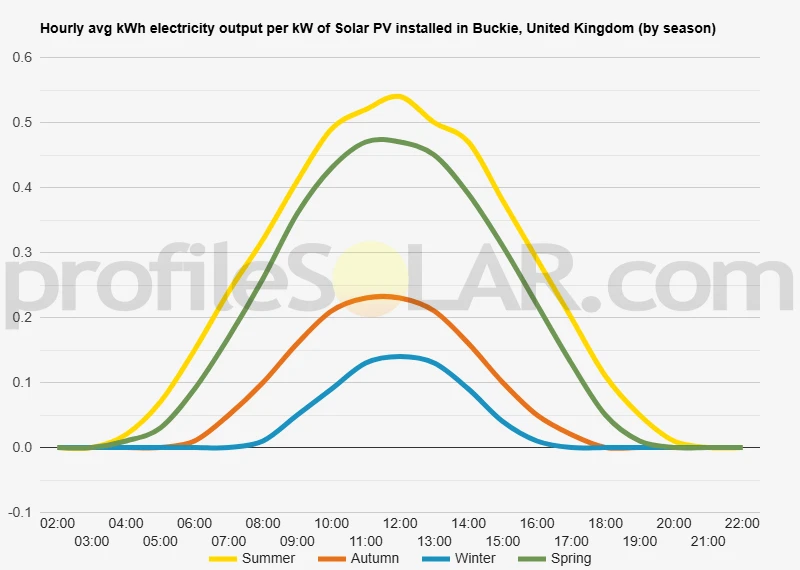
The solar energy output at Buckie varies dramatically throughout the year. Summer provides the strongest performance with 4.78 kWh per day for each kilowatt of installed solar capacity. Spring also offers good energy generation at 3.85 kWh per day per kW, making these two seasons the most productive times for solar power at this location. However, the location faces significant challenges during autumn and winter months. Autumn production drops to just 1.55 kWh per day per kW, while winter performance is particularly poor at only 0.70 kWh per day per kW. This represents a nearly seven-fold difference between peak summer and winter production.Optimal Panel Configuration
For maximum year-round energy production at Buckie, Scotland, solar panels should be installed at a fixed tilt angle of 48 degrees facing south. This angle has been calculated to optimize total annual output by accounting for the sun's changing position throughout the year and weighting the angles based on the actual solar energy potential for each day.Local Factors Affecting Solar Production
Several environmental and weather factors at Buckie can significantly impact solar energy generation:- Coastal salt spray: Being located near the North Sea, salt-laden air can accumulate on panel surfaces, reducing efficiency
- Frequent cloud cover: The Scottish climate brings regular overcast conditions that reduce solar irradiance
- High humidity and precipitation: Regular rainfall and moisture can affect panel performance and create maintenance challenges
- Strong coastal winds: While these can help keep panels clean, they also require robust mounting systems
Preventative Measures for Better Performance
Several installation strategies can help maximize solar energy production despite these local challenges: Regular cleaning schedules are essential to remove salt deposits and other debris that accumulate on panel surfaces. Installing panels with anti-reflective coatings and self-cleaning glass can help reduce maintenance requirements. Proper drainage systems should be incorporated into the installation design to prevent water pooling around panels. Using high-quality, corrosion-resistant mounting hardware is crucial in the coastal environment to ensure long-term structural integrity. Selecting solar panels with good low-light performance characteristics will help maintain energy generation during cloudy conditions. Additionally, ensuring adequate ventilation around panels helps prevent moisture buildup and maintains optimal operating temperatures. Wind-resistant mounting systems designed for coastal conditions will protect the installation from damage while allowing beneficial cleaning effects from moderate winds.Note: The Northern Temperate Zone extends from 35° latitude North up to 66.5° latitude.
So far, we have conducted calculations to evaluate the solar photovoltaic (PV) potential in 911 locations across United Kingdom. This analysis provides insights into each city/location's potential for harnessing solar energy through PV installations.
Link: Solar PV potential in United Kingdom by location
Solar output per kW of installed solar PV by season in Buckie
Seasonal solar PV output for Latitude: 57.6757, Longitude: -2.9624 (Buckie, United Kingdom), based on our analysis of 8760 hourly intervals of solar and meteorological data (one whole year) retrieved for that set of coordinates/location from NASA POWER (The Prediction of Worldwide Energy Resources) API:




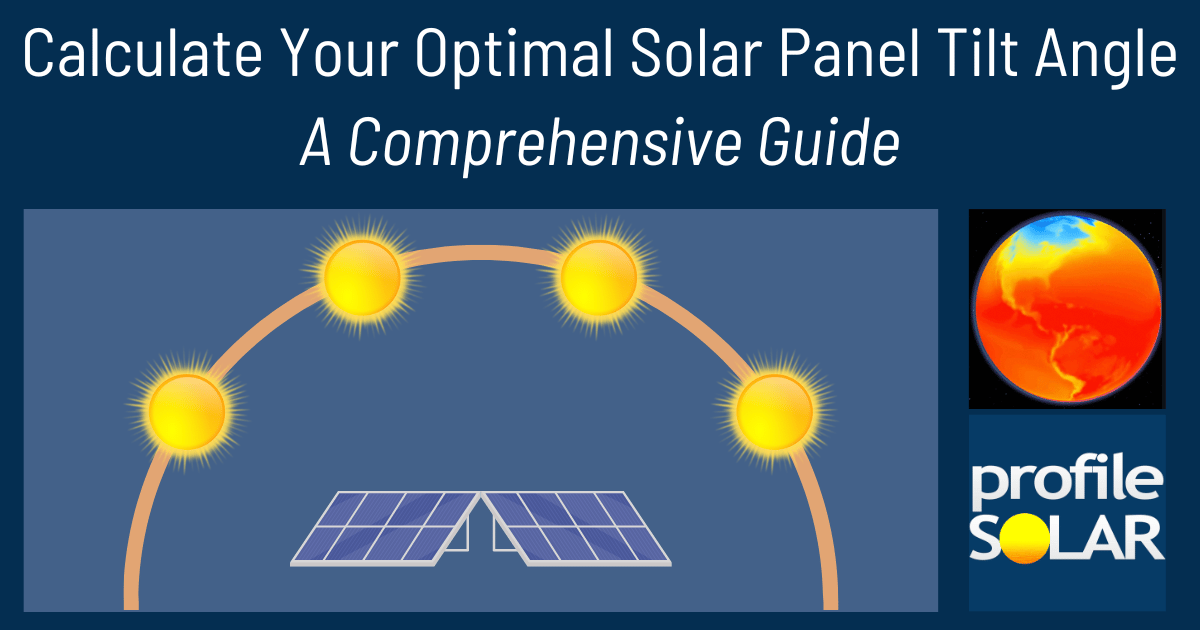
Ideally tilt fixed solar panels 48° South in Buckie, United Kingdom
To maximize your solar PV system's energy output in Buckie, United Kingdom (Lat/Long 57.6757, -2.9624) throughout the year, you should tilt your panels at an angle of 48° South for fixed panel installations.
As the Earth revolves around the Sun each year, the maximum angle of elevation of the Sun varies by +/- 23.45 degrees from its equinox elevation angle for a particular latitude. Finding the exact optimal angle to maximise solar PV production throughout the year can be challenging, but with careful consideration of historical solar energy and meteorological data for a certain location, it can be done precisely.
We use our own calculation, which incorporates NASA solar and meteorological data for the exact Lat/Long coordinates, to determine the ideal tilt angle of a solar panel that will yield maximum annual solar output. We calculate the optimal angle for each day of the year, taking into account its contribution to the yearly total PV potential at that specific location.

Seasonally adjusted solar panel tilt angles for Buckie, United Kingdom
If you can adjust the tilt angle of your solar PV panels, please refer to the seasonal tilt angles below for optimal solar energy production in Buckie, United Kingdom. As mentioned earlier, for fixed-panel solar PV installations, it is optimal to maintain a 48° South tilt angle throughout the year.
| Overall Best Summer Angle | Overall Best Autumn Angle | Overall Best Winter Angle | Overall Best Spring Angle |
|---|---|---|---|
| 41° South in Summer | 60° South in Autumn | 70° South in Winter | 50° South in Spring |
Our recommendations take into account more than just latitude and Earth's position in its elliptical orbit around the Sun. We also incorporate historical solar and meteorological data from NASA's Prediction of Worldwide Energy Resources (POWER) API to assign a weight to each ideal angle for each day based on its historical contribution to overall solar PV potential during a specific season.
This approach allows us to provide much more accurate recommendations than relying solely on latitude, as it considers unique weather conditions in different locations sharing the same latitude worldwide.
Calculate solar panel row spacing in Buckie, United Kingdom
We've added a feature to calculate minimum solar panel row spacing by location. Enter your panel size and orientation below to get the minimum spacing in Buckie, United Kingdom.
Our calculation method
- Solar Position:
We determine the Sun's position on the Winter solstice using the location's latitude and solar declination. - Shadow Projection:
We calculate the shadow length cast by panels using trigonometry, considering panel tilt and the Sun's elevation angle. - Minimum Spacing:
We add the shadow length to the horizontal space occupied by tilted panels.
This approach ensures maximum space efficiency while avoiding shading during critical times, as the Winter solstice represents the worst-case scenario for shadow length.
Topography for solar PV around Buckie, United Kingdom
Topographical Features Around Buckie
Buckie sits along the southern shore of the Moray Firth on Scotland's northeast coast, positioned where the land meets the North Sea. The town occupies a relatively flat coastal plain that extends inland from the rocky shoreline. This coastal strip is characterised by gentle undulations and low-lying terrain, with elevations rarely exceeding 50 metres above sea level in the immediate vicinity of the town.
Moving inland from Buckie, the landscape gradually rises towards the foothills of the Grampian Mountains. The terrain becomes increasingly rolling and hilly as distance from the coast increases, with scattered farmland, woodland patches, and moorland dominating the higher elevations. The Speyside region lies to the south and southwest, where river valleys cut through the landscape creating a mix of flat valley floors and steeper valley sides.
The coastline itself features a combination of rocky outcrops, small beaches, and harbour areas. Buckie's harbour and the surrounding coastal development occupy some of the flattest and most accessible land in the area. The immediate coastal zone benefits from relatively stable geology, though some areas experience coastal erosion typical of North Sea shorelines.
Optimal Areas for Large-Scale Solar Development
The most suitable locations for large-scale solar photovoltaic installations around Buckie would be found on the gently sloping agricultural land that extends inland from the coastal plain. These areas, typically located between one and five kilometres from the coast, offer the ideal combination of relatively flat terrain, good accessibility, and sufficient space for substantial solar arrays.
The coastal plain itself, while topographically suitable, presents challenges due to existing development, infrastructure, and the productive agricultural land that supports the local economy. However, marginal agricultural areas on slightly elevated ground inland from Buckie could provide excellent opportunities for solar development without competing directly with prime farming land.
South-facing slopes in the rolling countryside beyond the immediate coastal zone represent particularly attractive locations for solar installations. These areas benefit from natural drainage, reduced risk of flooding, and optimal orientation for solar collection. The gradual transition from coastal plain to upland areas creates numerous sites with gentle gradients that would minimise earthworks and construction costs while maximising solar exposure.
Areas to avoid would include the steeper terrain found further inland towards the Grampian foothills, where gradients become too pronounced for efficient solar panel installation. Similarly, the immediate coastal zone faces challenges from salt spray, stronger winds, and potential planning restrictions related to coastal management and existing infrastructure.
United Kingdom solar PV Stats as a country
United Kingdom ranks 14th in the world for cumulative solar PV capacity, with 13,689 total MW's of solar PV installed. This means that 4.00% of United Kingdom's total energy as a country comes from solar PV (that's 20th in the world). Each year United Kingdom is generating 203 Watts from solar PV per capita (United Kingdom ranks 25th in the world for solar PV Watts generated per capita). [source]
Are there incentives for businesses to install solar in United Kingdom?
Yes, there are several incentives for businesses wanting to install solar energy in the United Kingdom. The UK government offers a Feed-in Tariff (FiT) scheme which pays businesses for every unit of electricity they generate from their solar panels. Additionally, businesses may be eligible for tax reliefs such as Enhanced Capital Allowances and Renewable Heat Incentives. Finally, some local authorities offer grants or other financial support to help businesses with the cost of installing solar energy systems.
Do you have more up to date information than this on incentives towards solar PV projects in United Kingdom? Please reach out to us and help us keep this information current. Thanks!
Citation Guide
Article Details for Citation
Author: Aaron Robinson
Publisher: profileSOLAR.com
First Published: Monday 21st of July 2025
Last Updated: Thursday 7th of August 2025
Tell Us About Your Work
We love seeing how our research helps others! If you've cited this article in your work, we'd be delighted to hear about it. Drop us a line via our Contact Us page or on X, to share where you've used our information - we may feature a link to your work on our site. This helps create a network of valuable resources for others in the solar energy community and helps us understand how our research is contributing to the field. Plus, we occasionally highlight exceptional works that reference our research on our social media channels.
Feeling generous?

Share this with your friends!


Compare this location to others worldwide for solar PV potential
The solar PV analyses available on our website, including this one, are offered as a free service to the global community. Our aim is to provide education and aid informed decision-making regarding solar PV installations.
However, please note that these analyses are general guidance and may not meet specific project requirements. For in-depth, tailored forecasts and analysis crucial for feasibility studies or when pursuing maximum ROI from your solar projects, feel free to contact us; we offer comprehensive consulting services expressly for this purpose.

Helping you assess viability of solar PV for your site
Calculate Your Optimal Solar Panel Tilt Angle: A Comprehensive Guide
Enhance your solar panel's performance with our in-depth guide. Determine the best tilt angle using hard data, debunk common misunderstandings, and gain insight into how your specific location affects solar energy production.